Open Museum · Digital Exhibition
The Horse That Changed the World
For six thousand years the horse was the supercharger of human capability, the answer to distance, and at every turn each civilisation drew it as itself. Follow one animal across five cultures and six rooms, and watch what it took, in the end, to replace it.
How would you like to visit?
For six thousand years the horse was the supercharger of human capability. Nothing carried a person, an army, a message, or an empire further or faster, and nothing held that office for longer: the horse kept it from the Bronze Age to the nineteenth century, unseated by no rival animal, retired in the end only by a machine. Its reach is still in our mouths: the single largest language family on earth, spoken today by close to half of all people, was carried out of the grasslands by people who rode. Watch closely, because each civilisation drew the horse as itself. What you are looking at, in clay and ink and oil and stone, is six thousand years of cultures describing their own idea of power, and one animal patient enough to carry all of them.
The Weapon
The horse enters history as military technology. It got there twice. First as a ridden animal on the steppe, by a date and a route scholars still argue over; then as the engine of the chariot, a stronger animal bred to pull a light, spoked wheel, which the archaeology fixes among the Sintashta culture, east of the Urals, around 2000 BCE. The room begins with the second, the one we can prove. The chariot made the horse the decisive weapon of the Bronze Age; the Greeks inherited that machine and made it the image of heroic power. Centuries after the chariot was obsolete in war, painters were still reaching for it. This room follows that long afterlife.
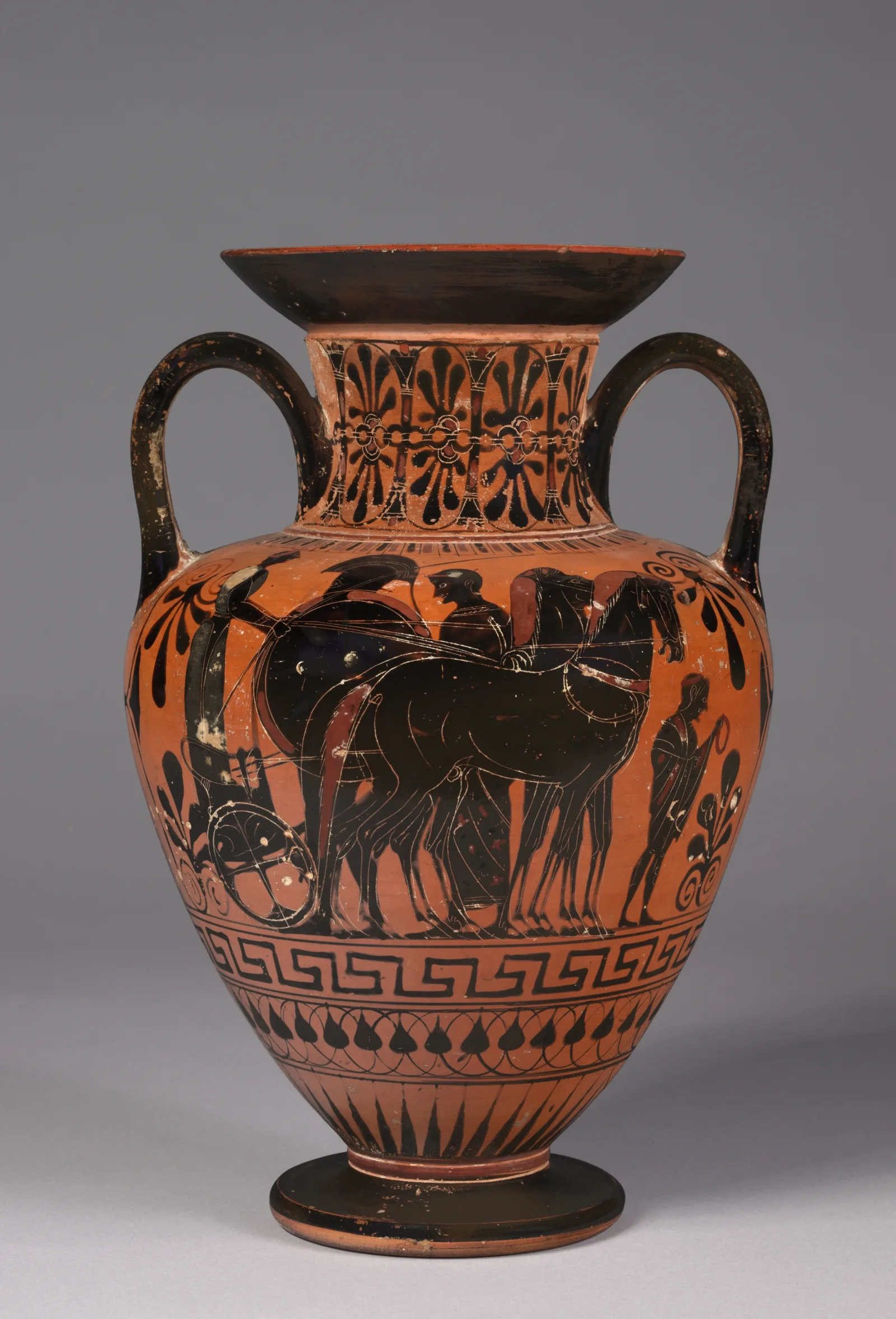
Black-Figure Neck-Amphora: Departing Warrior with Chariot
Greek, Attic, ca. 520–510 BCE · Ceramic · The Cleveland Museum of Art
Six centuries later the Greeks have decided what part of war to show, and it is not the battle. On this black-figure amphora of about 520 BCE a warrior stands beside his chariot team at the moment of leaving: the horses harnessed, the household watching, the violence still ahead and off the vase. The Greeks chose the threshold, the instant between home and war, and gave the horses the stillness of waiting. The animal here is not yet a weapon in use; it is the line a man crosses to become a soldier.
Collection note
Open-access, verified at source · CC0 · cleveland:111500 · Open Museum no. ST-26003-02 · available as a museum-grade print.
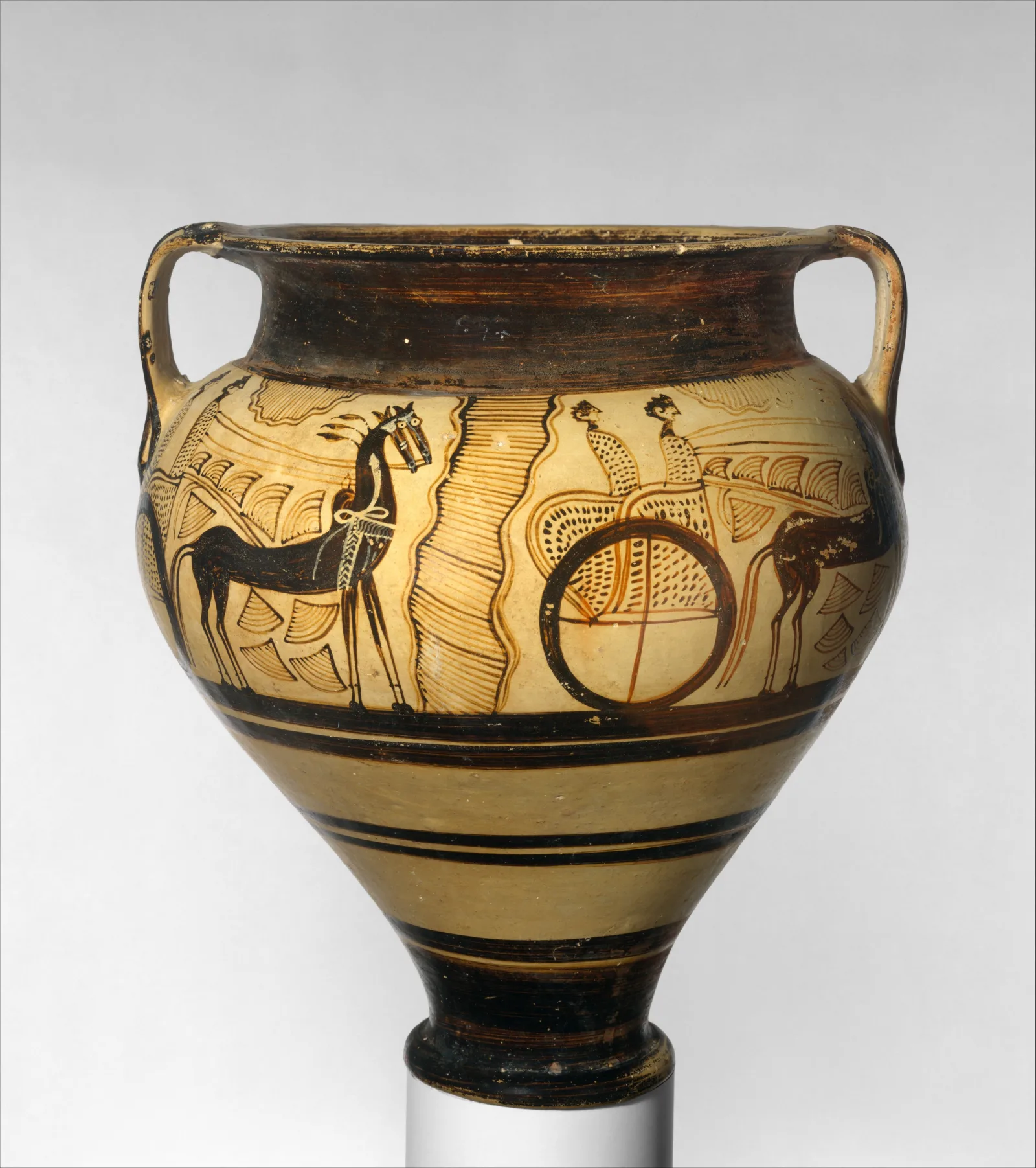
Terracotta chariot krater
Greek, Mycenaean, ca. 1375–1350 BCE (Late Helladic IIIA:1) · Terracotta · The Metropolitan Museum of Art
The earliest horse in this exhibition is painted, not carved, and it is already a status symbol. On this Mycenaean krater of about 1375 BCE, a chariot and its team ride in flat profile around a vessel made to hold wine at the funeral of someone who mattered. The horses are schematic, almost a pattern, but the message is not: to own a chariot was to be the kind of person buried with one painted at your side. The war machine has become an emblem of rank before it has even stopped being new.
Collection note
CC0 · met:240552 · Open Museum no. ST-26003-01
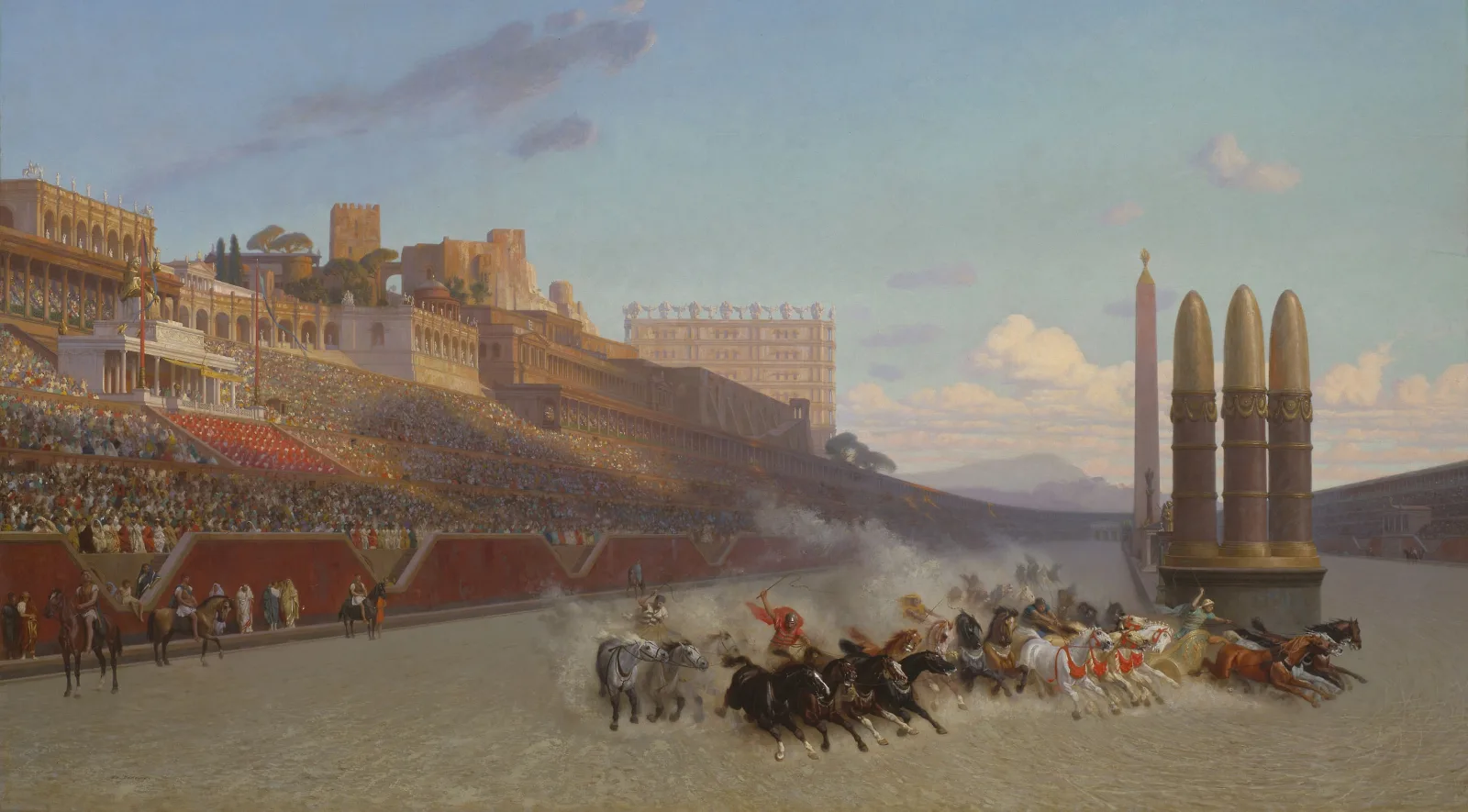
The Chariot Race
Jean-Léon Gérôme · French, 1876 · Oil on cradled panel · The Art Institute of Chicago
Gérôme paints a Roman circus in 1876, the chariots wheeling at the turn, the crowd a blur of marble and heat, every horse strained to the edge of control. Nothing about the technology survives into his century; the chariot is already an antique when he paints it. What survives is the wanting to look. The nineteenth century, on the verge of building machines that would finally outrun the horse, is still picturing the oldest race there is. We never stopped being fascinated, and Gérôme knows it.
Collection note
CC0 · aic:100350 · Open Museum no. ST-26003-03
The Bronze-Age chariot and Gérôme's 1876 chariot are the same fascination, thirty-two centuries apart.
From the weapon to the celestial horse
The Celestial Horse
For Tang China the horse was precious foreign cargo, brought down the Silk Road from Ferghana, far to China's west, at enormous cost, and it carried a charge of the divine. Emperors were buried with glazed horses to ride in the next world; aristocratic women rode in this one; and the imported Persian game of polo turned the animal into a field of play for the court. The horse here is no weapon: it is wealth, afterlife, and status, fired in clay.
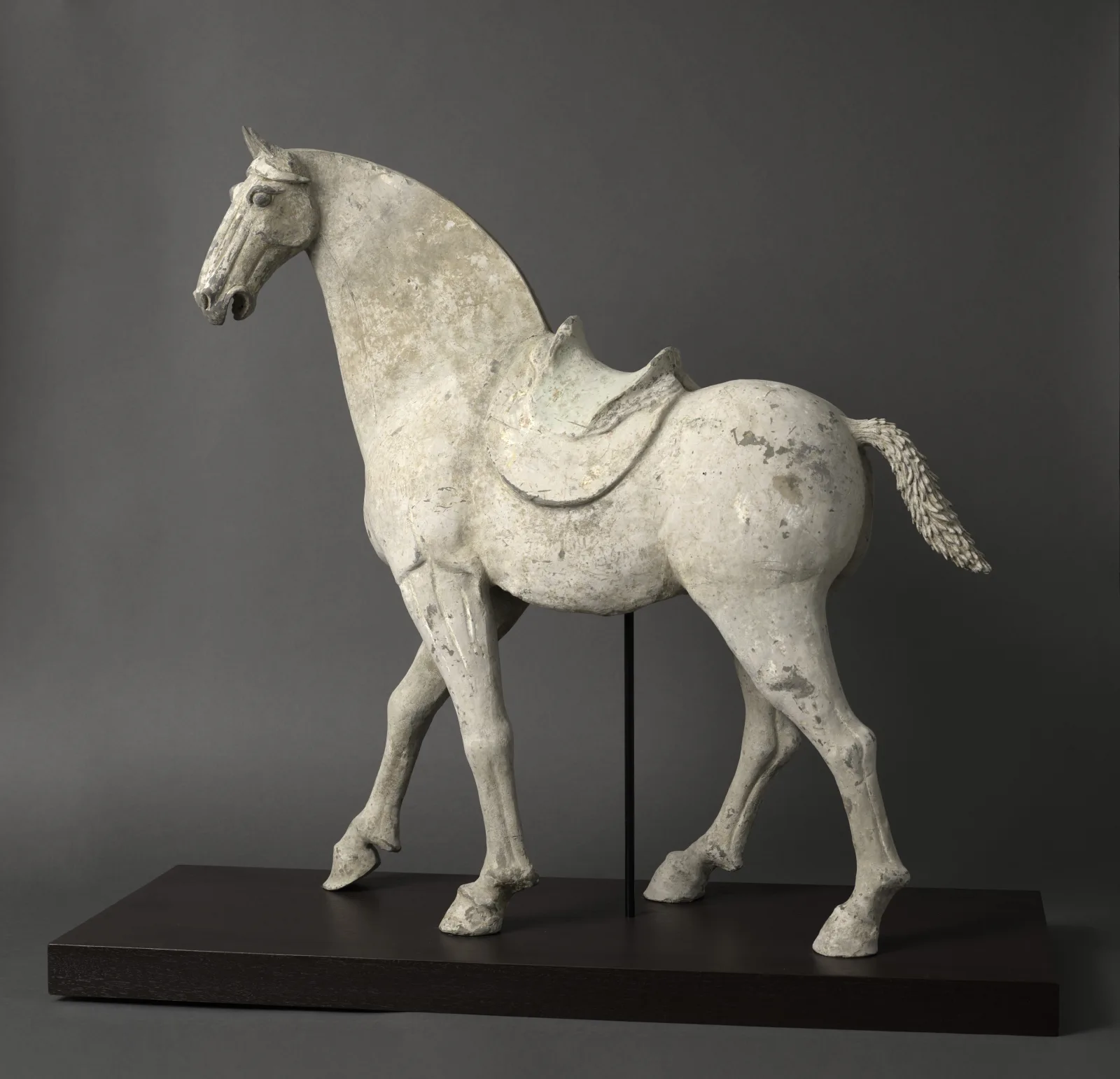
A Large Painted Striding Horse
China, Tang dynasty, 700–800s · Pottery with white slip and mineral pigments · The Cleveland Museum of Art
Where the sancai horse stands, this one moves. Built large in white-slipped pottery and painted rather than glazed, it strides with one foreleg lifted, a monumental presence made for the spirit road of a tomb, where figures lined the approach to the grave. Scale is the argument: this is the horse made grand, a funerary guardian sized to impress the living mourner and serve the buried dead. The Tang did not shrink the animal to a charm. They built it to the size of its meaning.
Collection note
Open-access, verified at source · CC0 · cleveland:84457 · Open Museum no. ST-26003-05 · available as a museum-grade print.
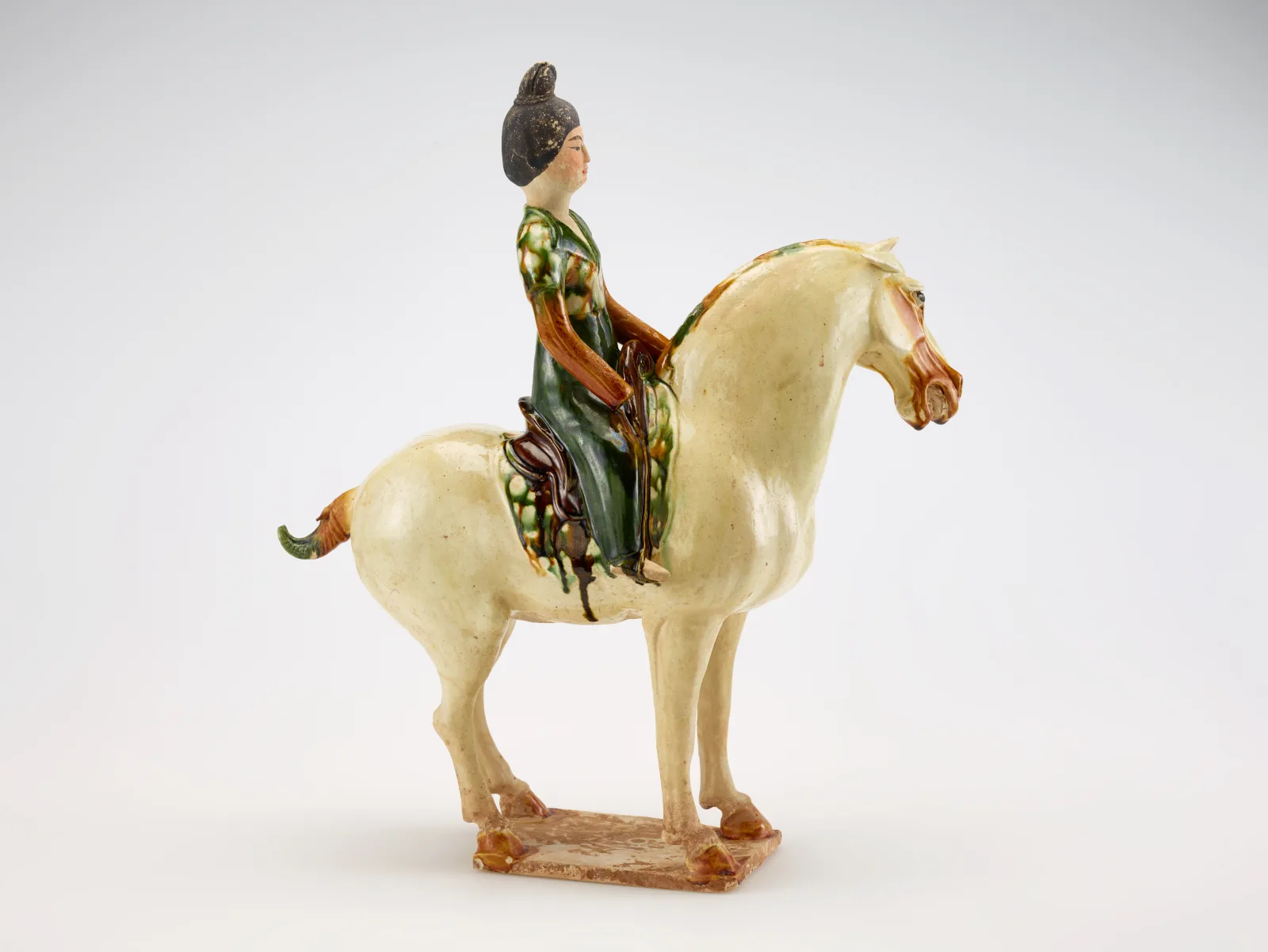
Tomb figure of a woman on horseback
China, Tang dynasty, ca. 700–750 · Earthenware with lead-silicate glazes · Smithsonian (National Museum of Asian Art)
Riding one of these horses, a woman. Tang aristocratic women rode, hunted, and played, and the tombs record it without apology: here a woman sits her mount with an ease the clay makes ordinary. The horse marks a freedom that later centuries in China would narrow. For the length of this dynasty, the most mobile thing a high-born woman could do was the most ordinary thing in the world, and the potter shows it plainly: a person, on a horse, going somewhere of her own.
Collection note
Open-access, verified at source · CC0 · smithsonian:ld1-1643390182193-1643390192061-0 · Open Museum no. ST-26003-06 · available as a museum-grade print.
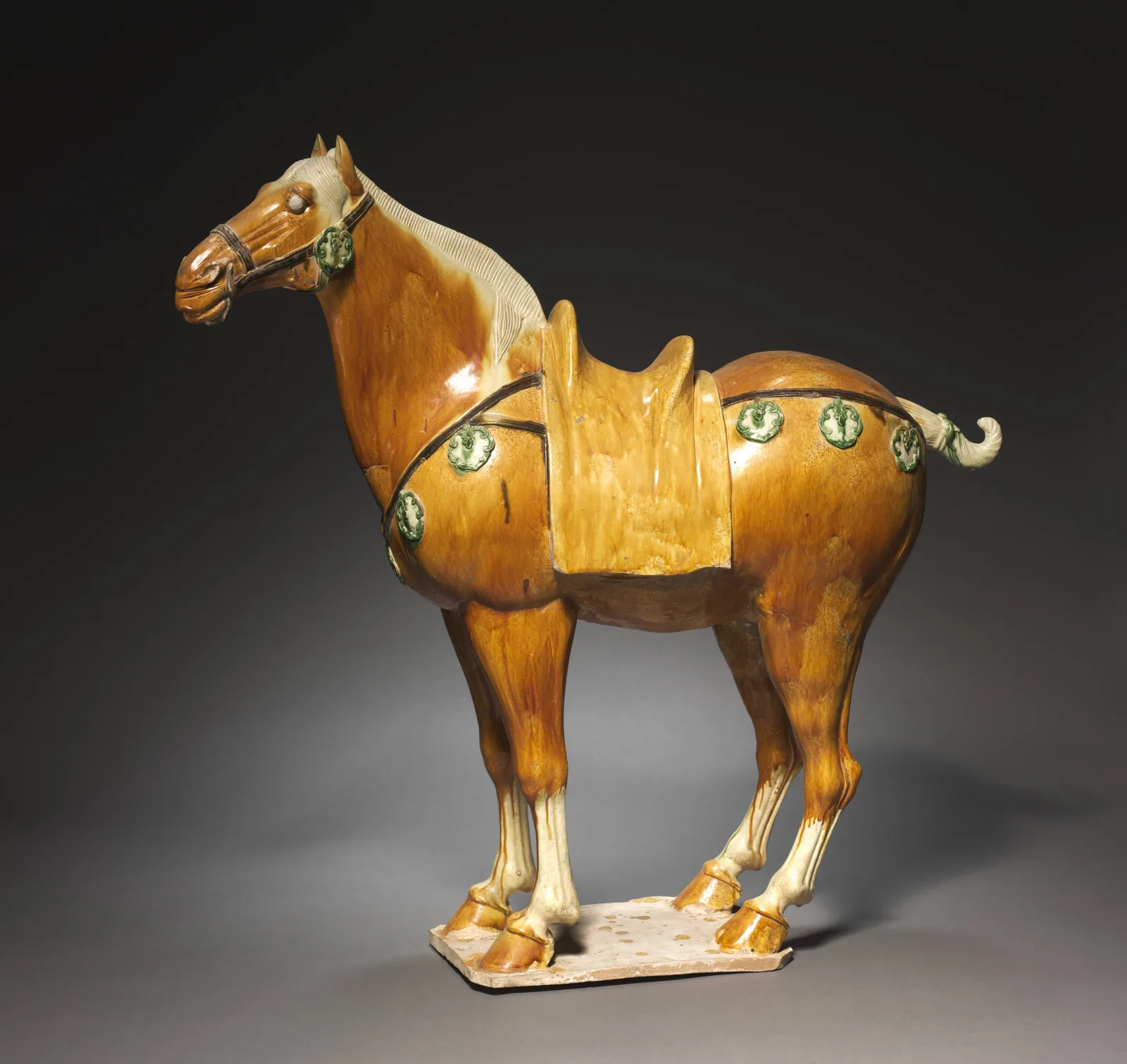
Horse
China, Tang dynasty, late 600s–800 · Sancai glazed earthenware · The Cleveland Museum of Art
This is the horse Tang China buried. Glazed in the streaked amber, green, and cream of sancai ware, it stands in perfect stillness, made not to be ridden but to be entombed, so its owner would not go on foot through eternity. The colours are the colours of the Silk Road, the trade route that brought the living animal east at the price of silk by the bale. To bury one in glazed earthenware was to keep, in the tomb, the most expensive thing the empire imported. The horse is treasure, and treasure is what you take to the dead.
Collection note
CC0 · cleveland:132819 · Open Museum no. ST-26003-04
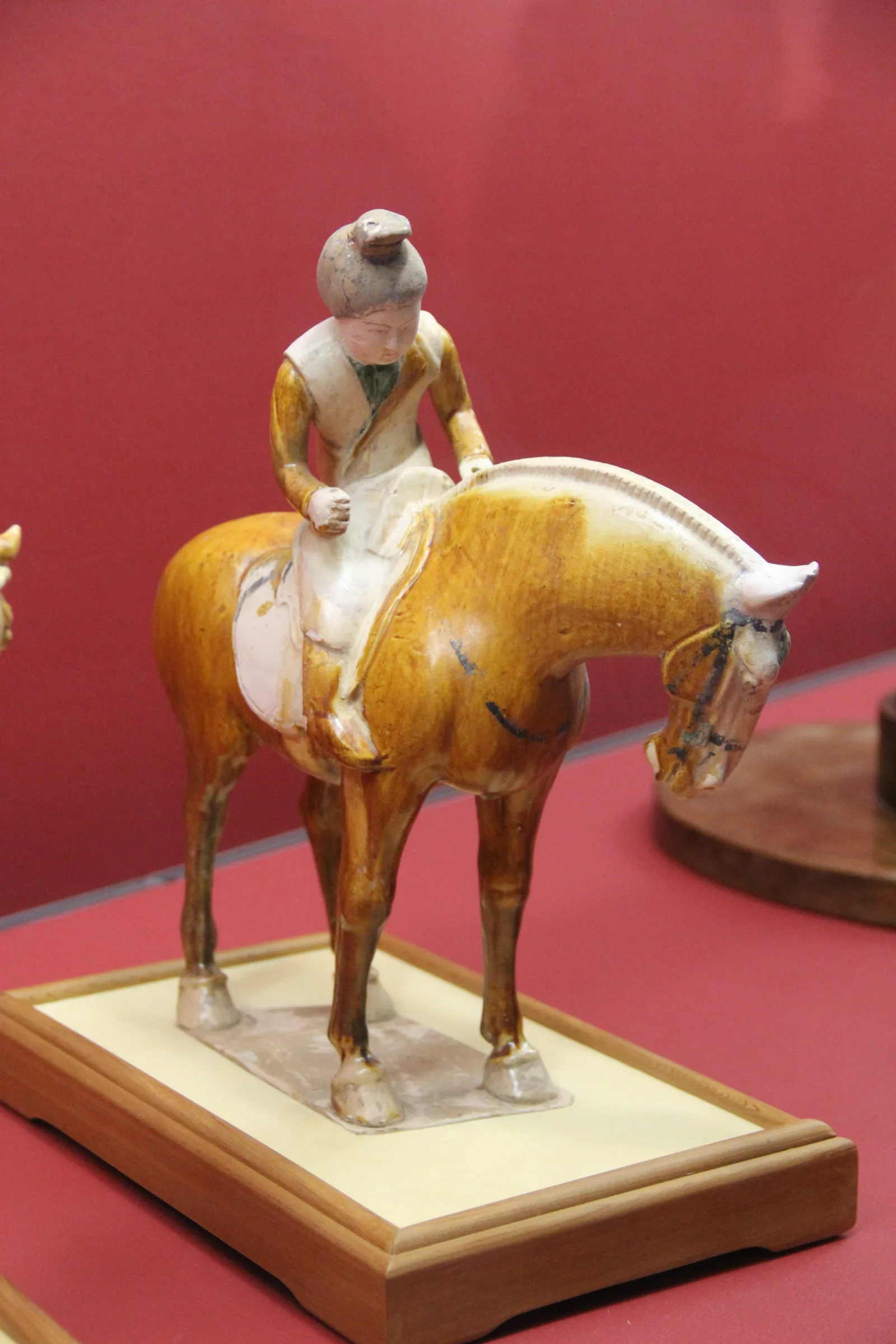
Sancai polo player
China, Tang dynasty, 618–907 · Sancai glazed earthenware · CC0 photograph (Gary Todd) of a museum object
The court at play, on a horse that arrived as an idea. Polo came to Tang China from Persia, and with the game came a whole posture of the body: leaning from the saddle, mallet swung, the rider and animal turned into a single line of motion. This small sancai figure carries more than a sport. It carries cultural transmission made visible, a Persian pastime fired in Chinese clay, the horse as the thing that moves customs as well as people. The game points west, toward the next room.
Collection note
CC0 · wikimedia:99814925 · Open Museum no. ST-26003-07
The polo player came to China from Persia. The horse is already carrying culture between civilisations, and Persia is where it goes next.
From the treasure to the king's right
The King's Right
In the Persian tradition the highest image of a ruler is a man on a horse doing something difficult: striking a target at the gallop, or riding down game. To ride and shoot like a king was not a metaphor for fitness to rule. It was the proof of it, performed in the saddle and recorded on the page in ink, gold, and bright pigment. This room ends by handing the Persian art of the mounted king eastward, to the Mughal court of India, carried there by the very painter on its central plate.
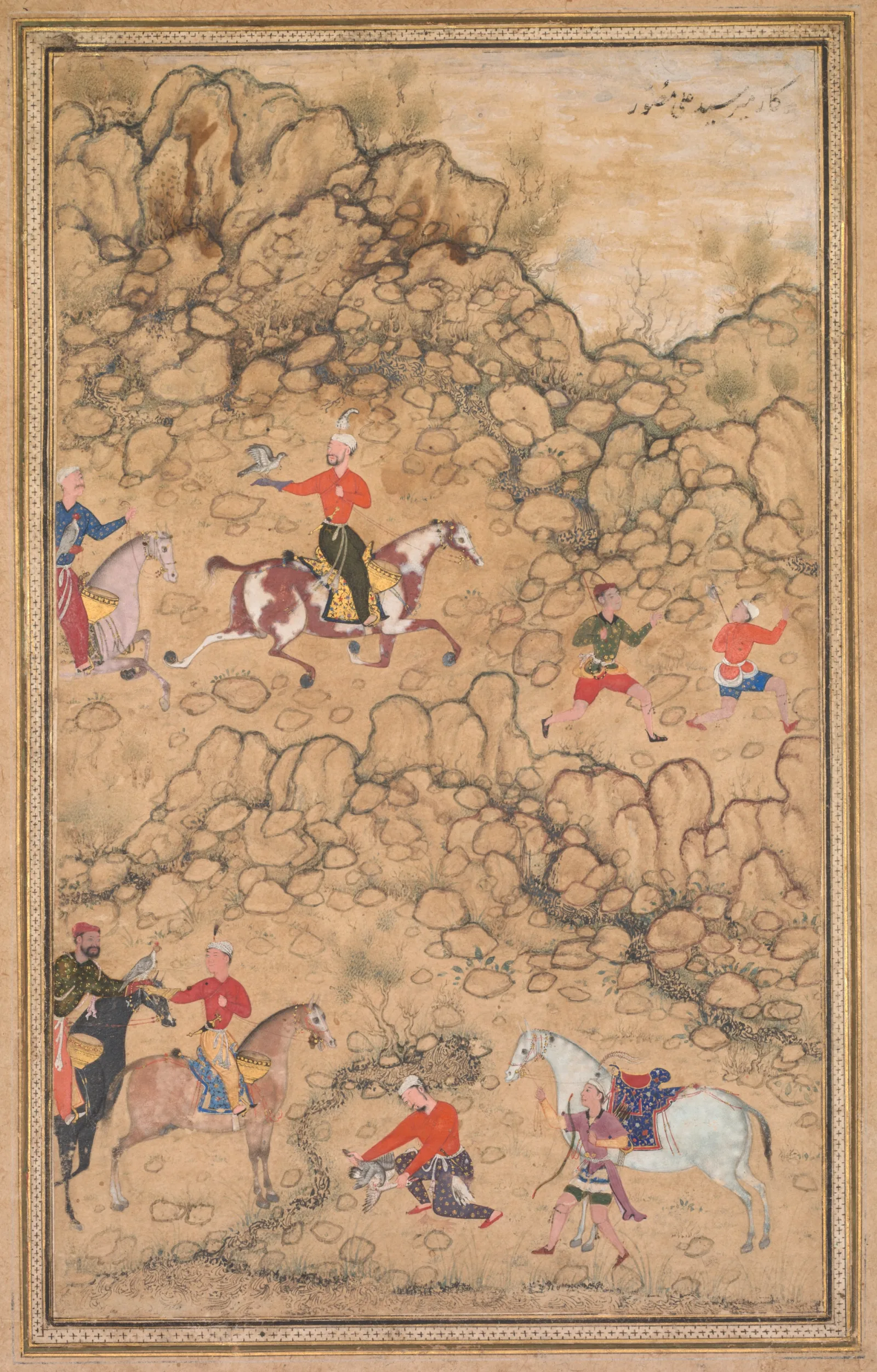
Hunting with Falcons in a Landscape
Abd al-Samad · Persian, active at the Mughal court, c. 1558–60 · Gum tempera, ink and gold on paper · The Cleveland Museum of Art
The royal hunt as the supreme image of rule, and a quiet hinge between two empires. Around 1558 the Persian master Abd al-Samad paints a falcon hunt in a gold landscape, the king mounted, the hawk loosed, the whole world arranged around the rider, exactly the claim this room is built on. But the maker carries a second meaning the page cannot show. Abd al-Samad left Safavid Persia for the court of the Mughal emperors and there founded the imperial painting workshop that would define Mughal art for a century. The Persian way of putting a king on a horse did not stay in Persia. It travelled to India in the hand that painted this. The crossing the next room turns on has already begun, here, in a painter’s biography.
Collection note
Open-access, verified at source · CC0 · cleveland:170784 · Open Museum no. ST-26003-09 · available as a museum-grade print.
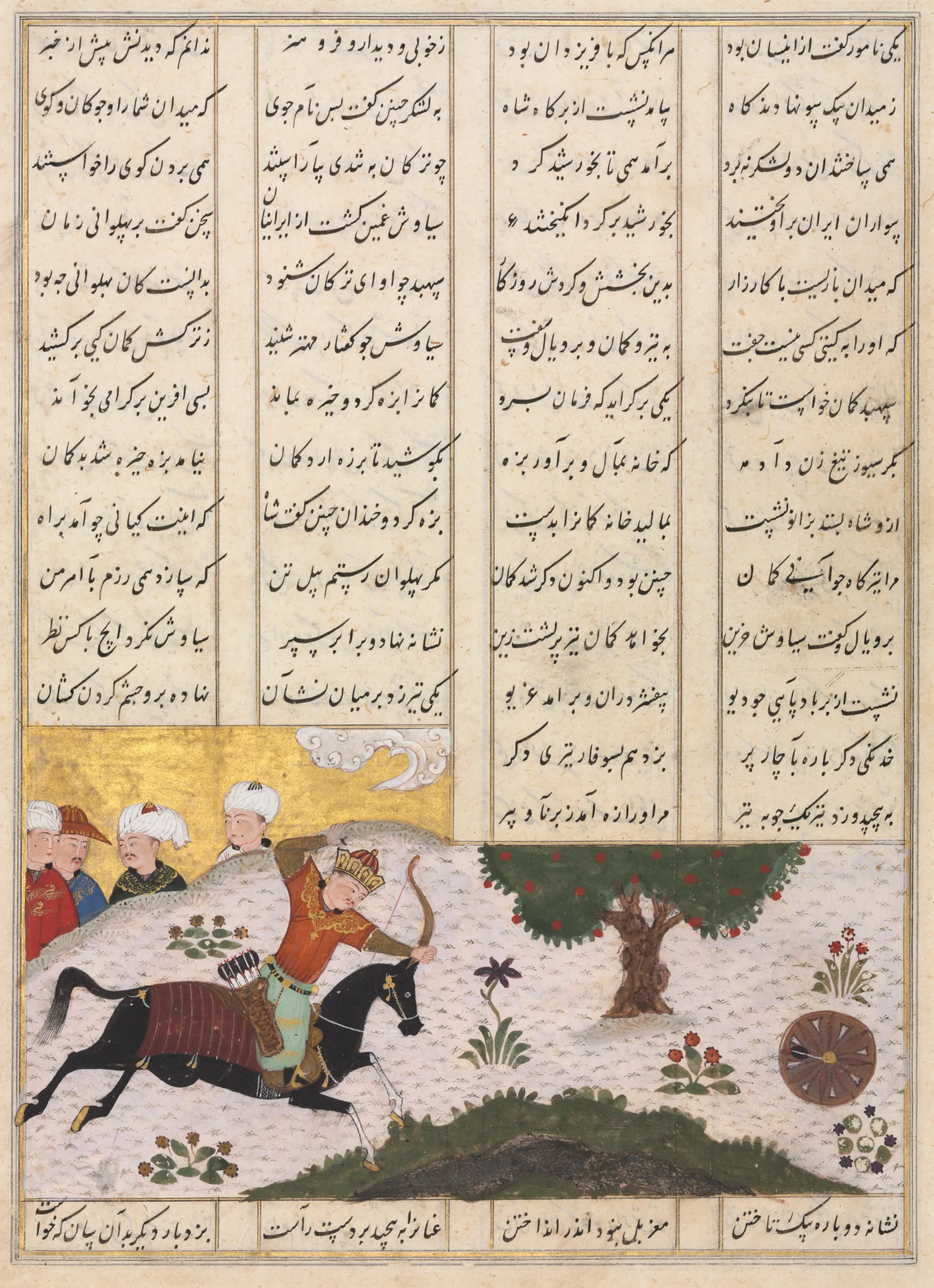
Siyavush on His Horse Hitting a Rolling Target, from a Shahnama (Book of Kings) of Firdausi
Persian, late 15th century · Opaque watercolour, silver, gold and ink on paper · The Cleveland Museum of Art
Here is horsemanship as the argument for a throne. Siyavush, the doomed prince of the Shahnama, gallops past a target raised on a pole and twists in the saddle to strike it, the test of riding and aim that a Persian king's son was expected to pass. Painted in the late fifteenth century in opaque colour, silver, and gold, the page makes the skill the point: the prince is legitimate because he can do this, on a horse, at speed. The Persian book of kings does not separate the rider from the ruler. To sit and shoot like this was to be seen as fit to reign.
Collection note
Open-access, verified at source · CC0 · cleveland:122620 · Open Museum no. ST-26003-08 · available as a museum-grade print.
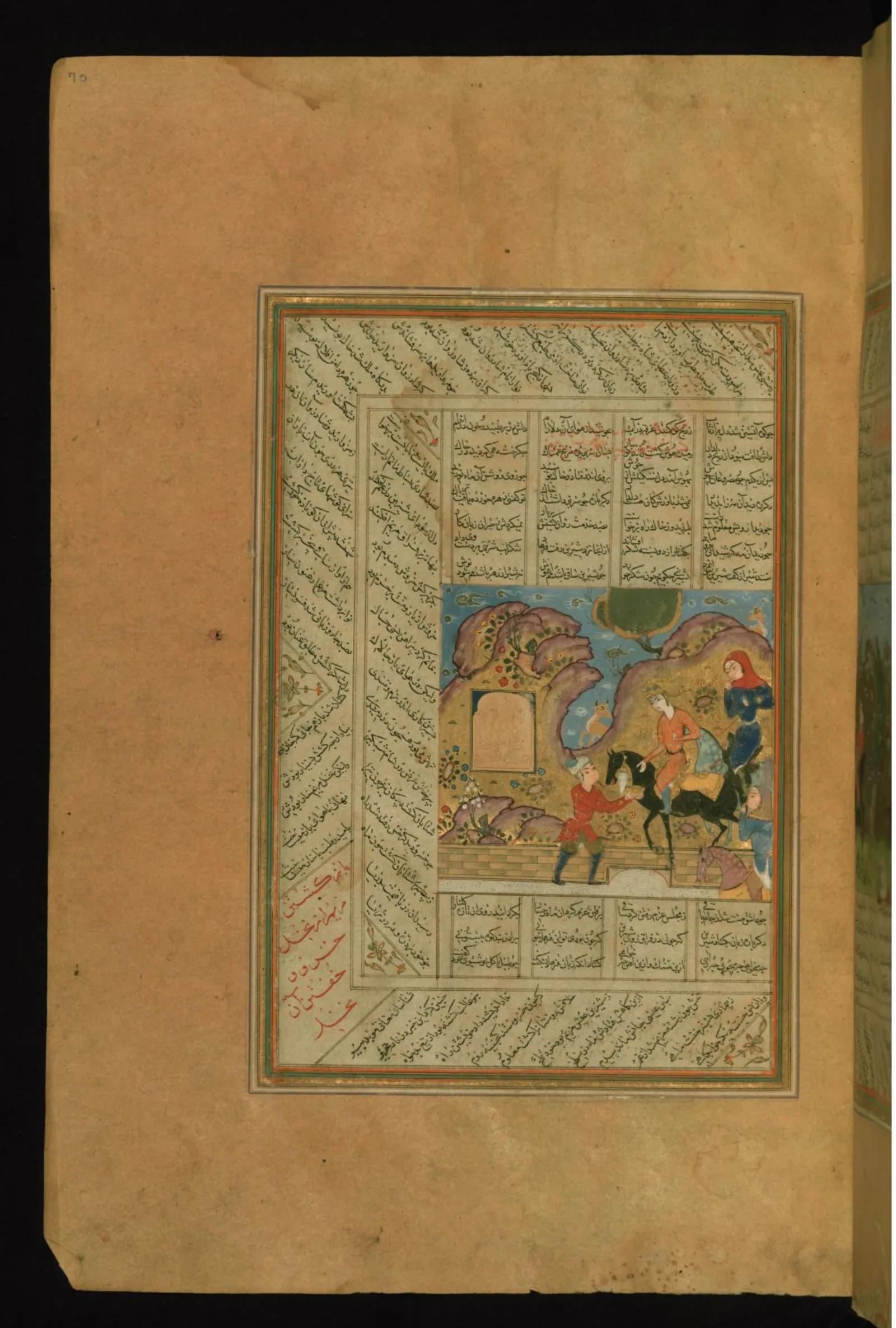
Shirin on Horseback Giving a Drink to Farhad, from a Khamsa
Persian, 16th century · Ink and pigments on tinted paper; text of Amir Khusraw Dihlavi · The Walters Art Museum
The same horse carries love as well as power. This small sixteenth-century page shows Shirin, the princess of Persian romance, leaning from her saddle to give water to Farhad, the stonecutter who labours and dies for love of her. The mount that means kingship everywhere else in this room here means tenderness, the same animal, the same gold ground, a wholly different charge. No other tradition in this exhibition asks so much of the horse. Elsewhere it carries a single idea, power, and carries it absolutely; the Persian horse is supple enough to hold a king’s authority and a lover’s mercy without changing its line. That is its distinction on these walls: it is the most human of the animals here, trusted to carry not just the wish to rule but the wish to be kind.
Collection note
CC0 · walters:83294 · Open Museum no. ST-26003-10
The painter of the falcon hunt, Abd al-Samad, carried this Persian art of the mounted king to Mughal India and built the workshop that ran it. The equestrian image is already moving between civilisations. The next room is where it keeps going, all the way to a Dutchman's drawing table.
From the king's right to power made visible
Power Made Visible
The equestrian portrait is the oldest format in public relations. To be painted on a horse was to claim command, to be shown raised, mounted, and in control of a powerful animal that stood for the people and the state beneath you. The format crystallised in Renaissance Europe and then did what no propaganda is supposed to do: it travelled, downward through the classes and outward across civilisations, until a European master sat copying an Indian one whose own tradition a Persian had founded.
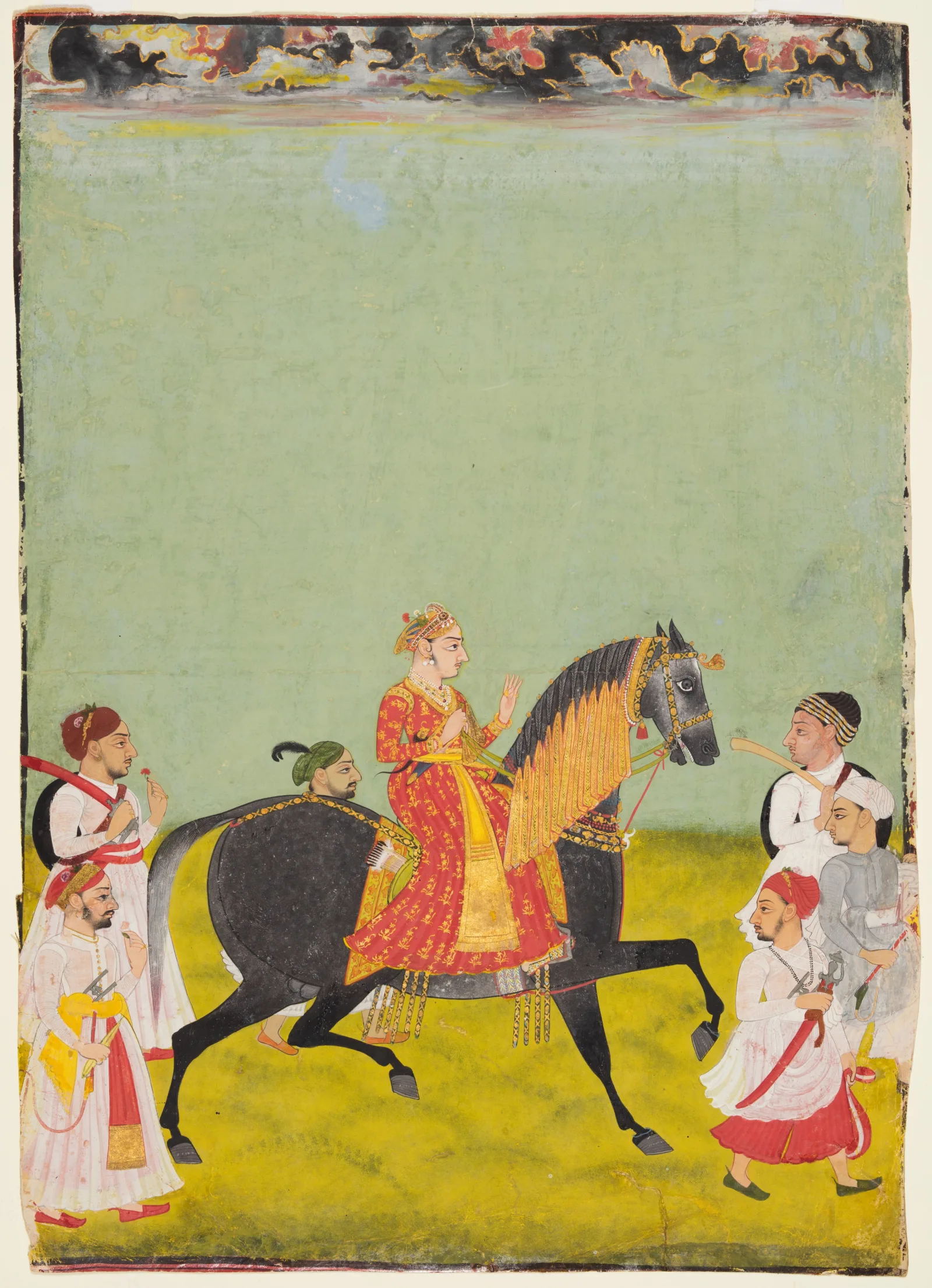
Equestrian Portrait of Maharana Raj Singh II of Mewar (r. 1755–62)
India, Mewar (Rajput), c. 1760 · Gum tempera and gold on paper · The Cleveland Museum of Art
The same claim, sovereign in India, and made for a named king. Around 1760 a Mewar painter sets Maharana Raj Singh II on his horse in strict profile, the animal groomed and gilded, the ruler riding across a pale green ground that holds nothing but him. This is not a copy of the European format and owes it no debt; it is the equestrian portrait arrived at on its own terms in Rajasthan, because the logic is the same everywhere a horse means power. To set a king on a fine mount and paint him in profile says the same thing in Udaipur that it says in Dordrecht and Augsburg. The difference is only the throne.
Collection note
Open-access, verified at source · CC0 · cleveland:314453 · Open Museum no. ST-26003-13 · available as a museum-grade print.
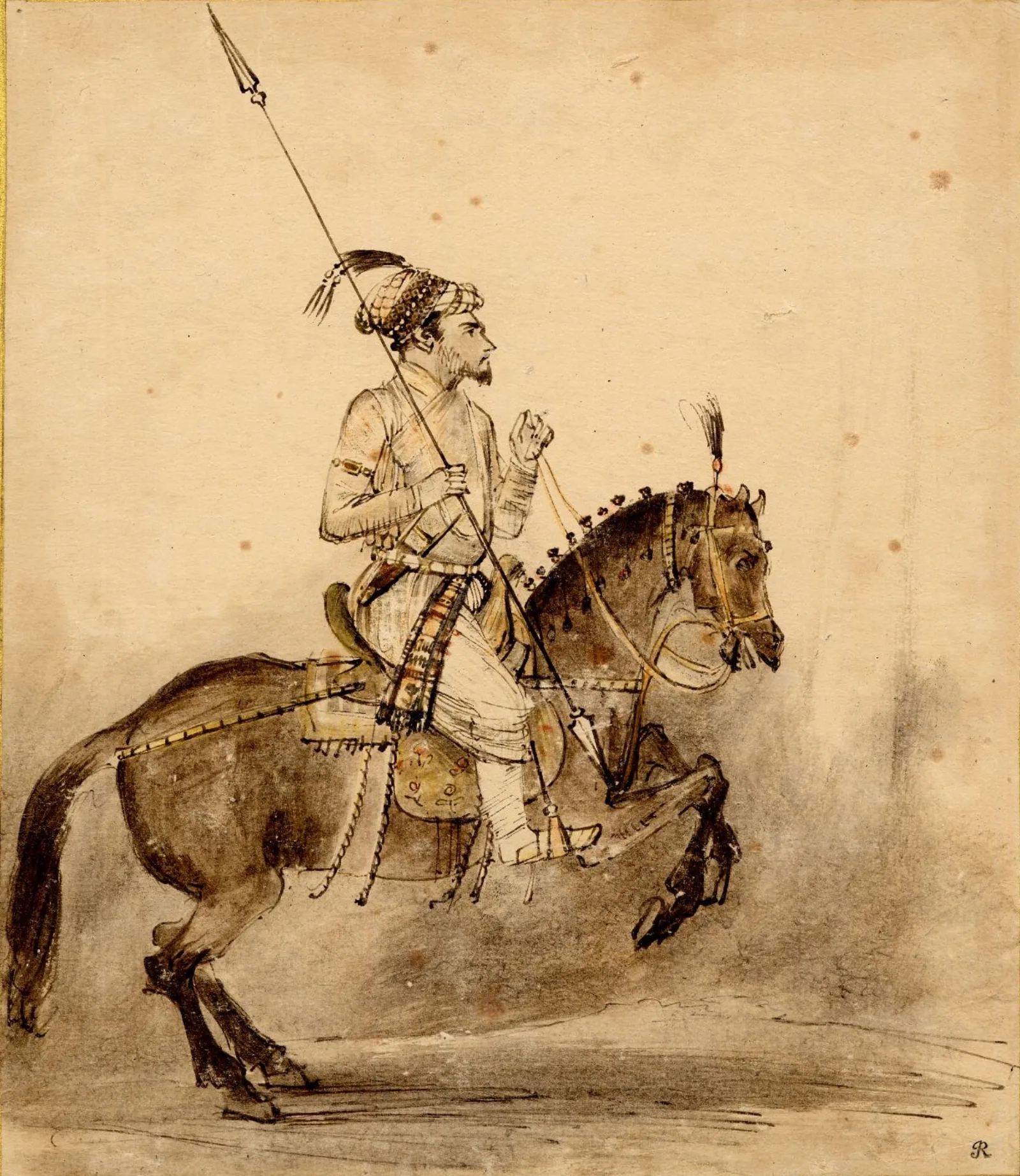
The keystone, shown small
A Mughal Nobleman on Horseback (after a Mughal miniature)
Rembrandt van Rijn · Dutch, c. 1656–61 · Pen and brown ink · British Museum
On a single small sheet, the horse crosses civilisations in front of you. Around 1656 Rembrandt, in Amsterdam, sat and copied a Mughal miniature of a nobleman on horseback, drawing an Indian equestrian portrait in his own hand, in brown ink, to learn from it. Set it beside the works it answers, the Mewar king and the Mughal hunt two and three plates back, and the whole thesis of the exhibition stands in one place: the format passed from Persia to Mughal India and on to a Dutch master, not by conquest or the trade in goods but by an artist choosing to study another civilisation’s way of putting a man on a horse. The drawing is small because the surviving sheet is small; keep it that way, and let its smallness sit against the large originals it learned from. The horse is the thing all of these traditions agreed was worth depicting, and the agreement is visible in the lines of a European hand following an Indian one.
Collection note
Public domain · wikimedia:16874622 · Open Museum no. ST-26003-14
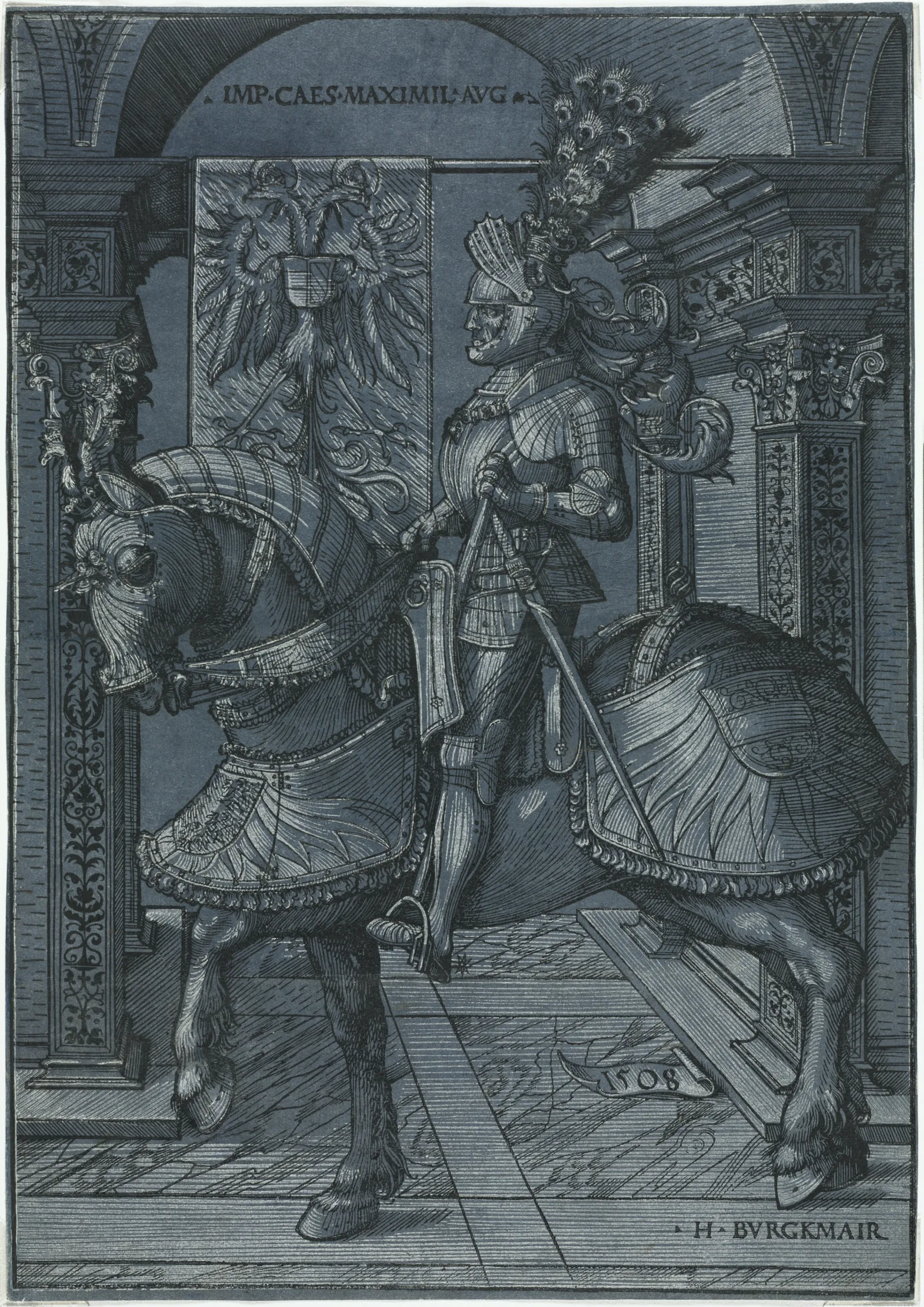
Equestrian Portrait of the Emperor Maximilian I
Hans Burgkmair the Elder · German, 1508 · Woodcut in black, heightened with gold, on vellum · The Art Institute of Chicago
The format at its most imperial. Burgkmair cuts the Holy Roman Emperor in armour on a striding horse, the block printed in black and heightened with gold on vellum, an object made to look like sovereignty itself. Everything is pitched to overwhelm: the raised animal, the metal, the gold, the emperor riding out of the page toward you. This is the equestrian portrait doing exactly what it was built to do, turning a man on a horse into the image of a right to rule.
Collection note
CC0 · aic:12791 · Open Museum no. ST-26003-11
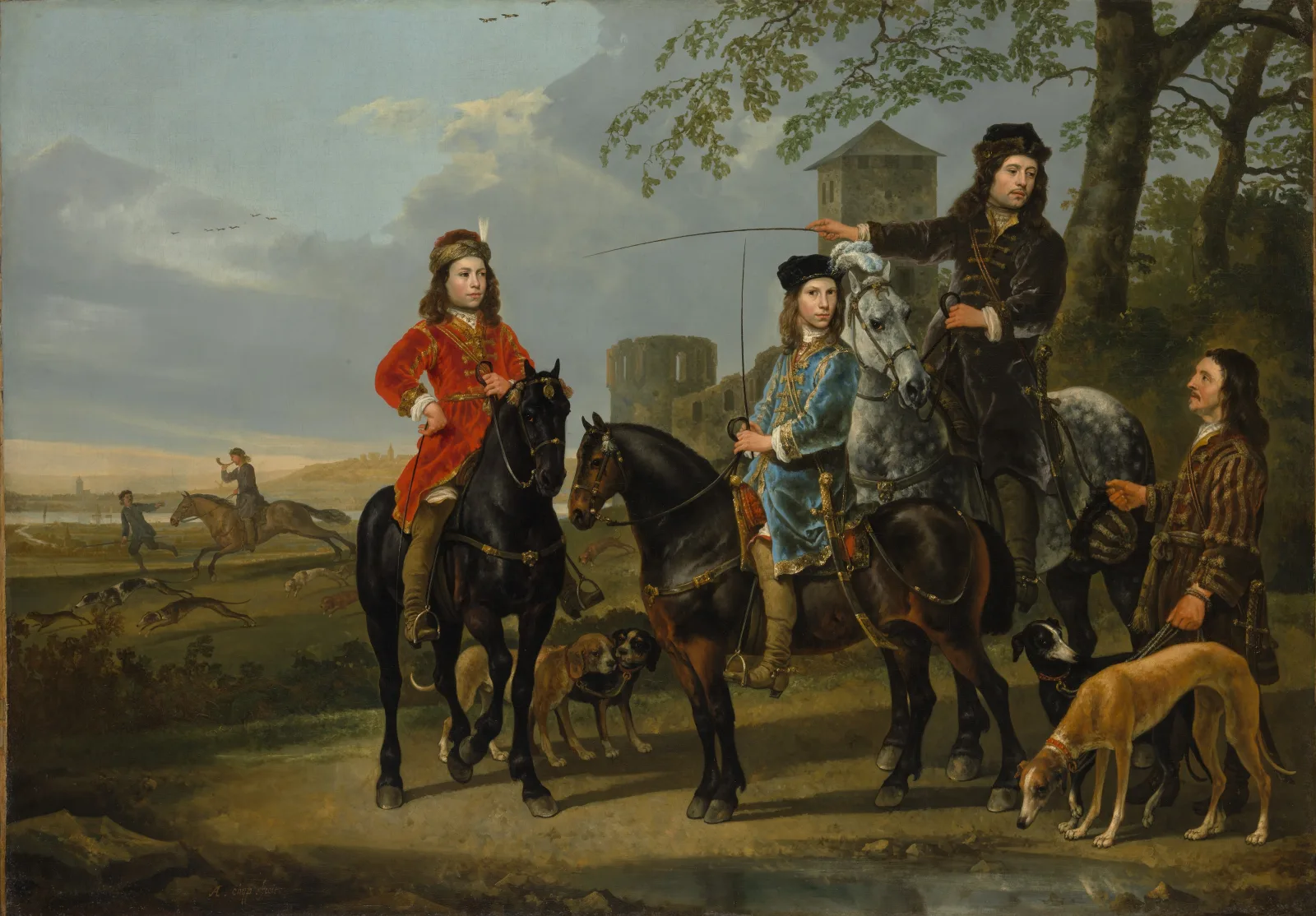
Equestrian Portrait of Cornelis and Michiel Pompe van Meerdervoort with their Tutor and Coachman
Aelbert Cuyp · Dutch, ca. 1652–53 · Oil on canvas · The Metropolitan Museum of Art
Now the same format steps down a class. Cuyp paints two sons of the Pompe van Meerdervoort family, regents of Dordrecht, on horseback with their tutor and a coachman, in the wide gold light of the Dutch countryside. These are not kings; they are the children of a Republic’s governing class, and they have commissioned the emperor’s format for themselves. The horse that meant sovereignty in Burgkmair’s vellum here means standing, lineage, the confidence of a family that rules a city rather than an empire. The propaganda machine has been bought by the patriciate, and it works just as well a size smaller.
Collection note
CC0 · met:436063 · Open Museum no. ST-26003-12
The cultural fingerprint
The image of the mounted man as authority spreads across the world, but it does not follow bloodlines or even the animal itself. It takes hold in Tang China, in the Mongol courts, in Mughal India, in Rajput Mewar, in Benin, among peoples with no common ancestry and, in some cases, barely a horse to spare. The meaning travelled further than the animal or its riders ever did. That is the deepest mark the horse left, and it is a cultural one: not who rode, but what riding came to mean, copied from court to court until a man on a horse meant power almost everywhere a man had seen one.
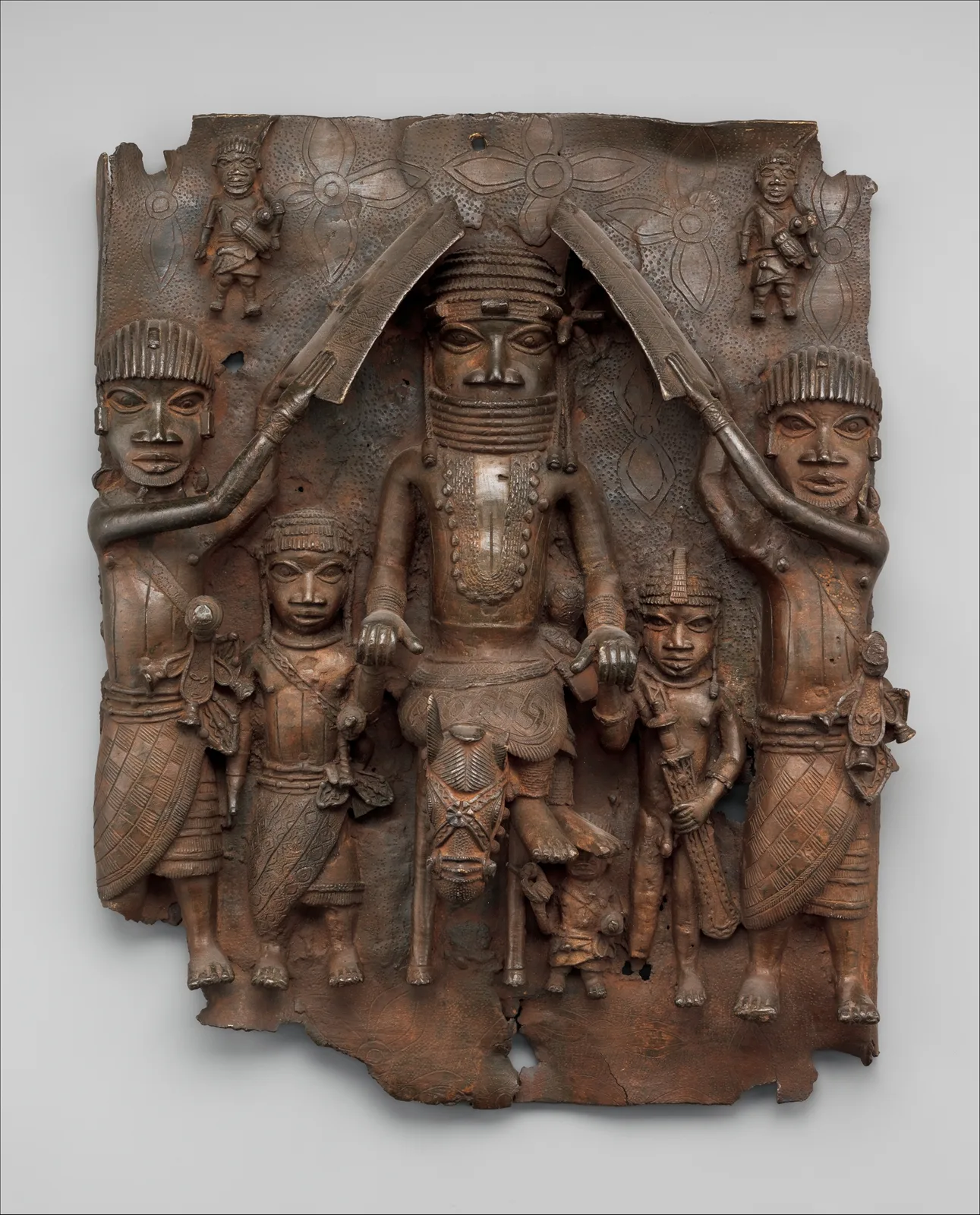
Plaque with equestrian ọ́bà (king) and attendants
Ìgùn Ẹ́rọ̀nwwọ̀n (brass-casting guild) artists · Edo peoples, Court of Benin, Nigeria, ca. 1540–70 · Brass · The Metropolitan Museum of Art
The proof that the mounted king travelled the whole world, and the one work in this exhibition whose history is a wound. We show it, and we name what was done to it.
Everything in this room has argued that a man on a horse came to mean power almost everywhere a horse was seen. Here is the furthest proof, cast in brass. The horse reached West Africa across the Sahara by trade, and in the kingdom of Benin the mounted figure, rare and costly in a place where horses were hard to keep, became the supreme image of the ọ́bà's power, with no steppe ancestry behind it and barely a horse to spare. This plaque was cast for that meaning by the Ìgùn Ẹ́rọ̀nwwọ̀n, the court's brass-casting guild, around the middle of the sixteenth century, one of some nine hundred made to sheathe the pillars of the royal palace in Benin City.
It belonged somewhere exact. In 1897 a British force sacked Benin City, sent the ọ́bà, Ọ̀vọ́nránmwẹ̀n, into exile, and plundered the palace. Some two hundred of the palace works went to the British Museum through the Foreign Office; others were sold on the international art market. This one surfaced in England within a year of the sacking, sat in a single collection for six decades, and in 1957 passed through three dealers, in London, Paris, and New York, before entering the collections that brought it to the Metropolitan Museum. It was not acquired. It was taken. The torn edges and the nail holes are the marks of its removal, and we have left them in view.
Its return, and who should decide what is done with its image, are contested and unresolved. We show it because to leave the wall empty would only repeat the erasure, and we say plainly on what terms. No ask has reached us, from Benin City or from Nigeria, that works like this be kept from view. If such an ask comes, we take it down at once.
Collection note
CC0 · met:310752 · Open Museum no. ST-26003-21
From power made visible to the horse freed
The Horse Freed
In its final century the horse is released, from king and god and emperor, into science, sport, and the crowd. It becomes a subject for its own sake: raw animal power at a public market, modern speed at the races, a poster on a city wall. For the first time it is painted as itself, not as somebody's claim to power. The room is a freedom and an elegy at once.
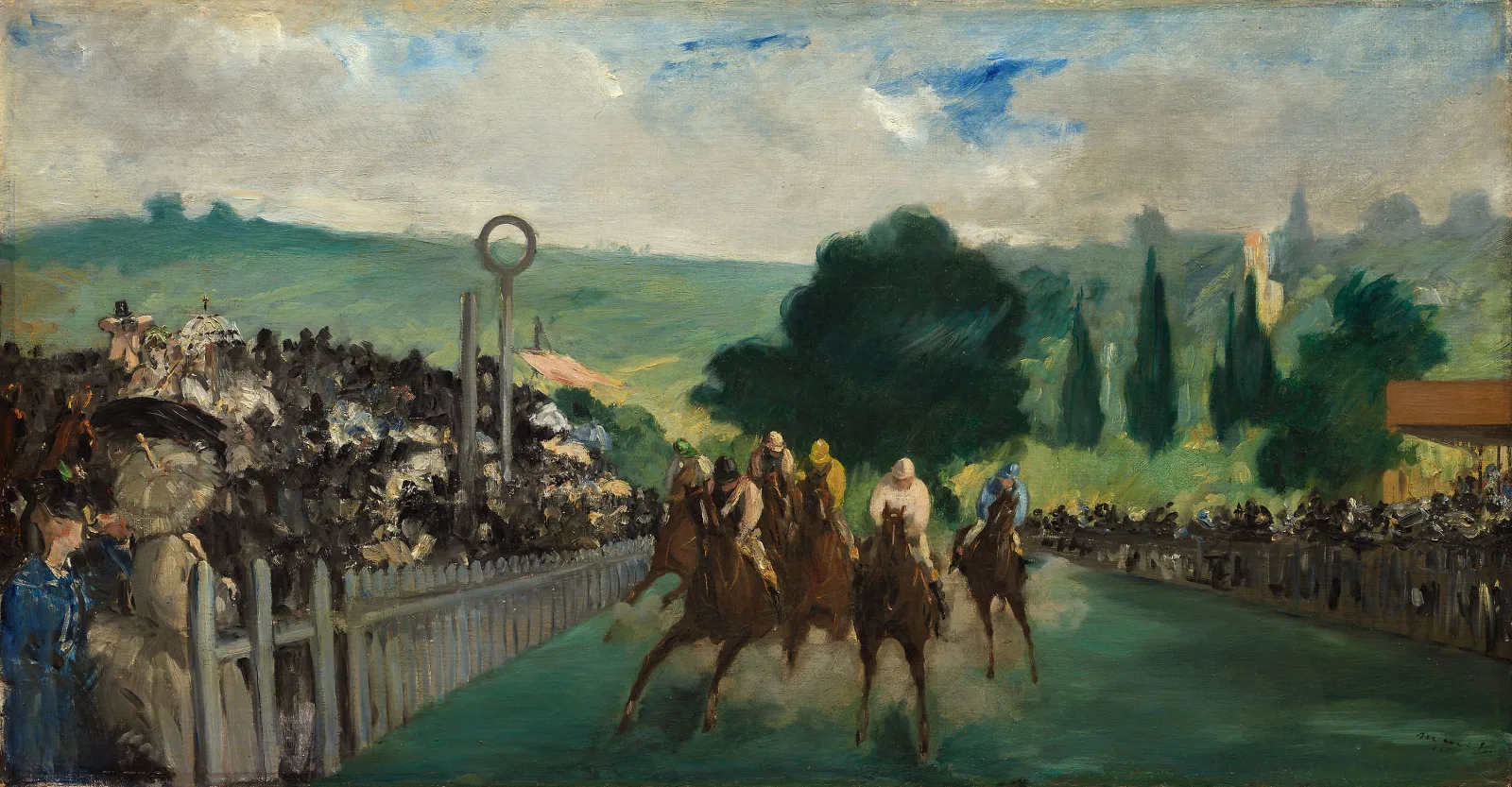
The Races at Longchamp
Édouard Manet · French, 1866 · Oil on canvas · The Art Institute of Chicago
Manet turns the horses to face you. At Longchamp the field gallops straight down the track toward the viewer, a compositional shock in 1866, the animals blurred into speed, the crowd a smear of modern leisure along the rail. Earlier centuries showed the horse in profile, the better to admire it; Manet shows it coming at you, because what he is painting is no longer the animal’s nobility but its velocity, the new pace of a century that has started to measure everything. The horse has become modern by aiming itself at the audience.
Collection note
Open-access, verified at source · CC0 · aic:81533 · Open Museum no. ST-26003-16 · available as a museum-grade print.
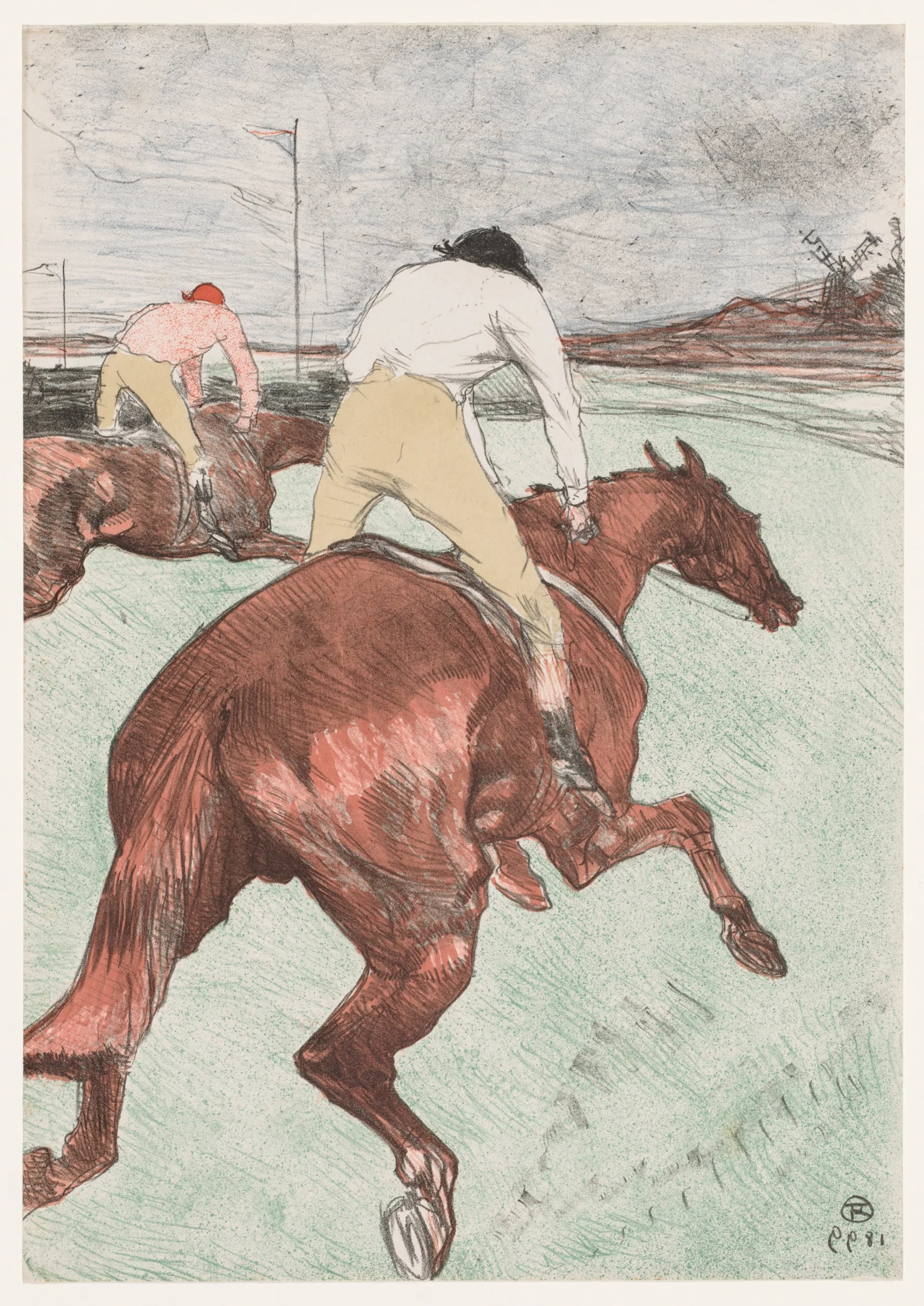
The Jockey
Henri de Toulouse-Lautrec · French, 1899 · Colour lithograph · The Cleveland Museum of Art
Finally, the horse becomes a print. Toulouse-Lautrec’s jockey of 1899 is a colour lithograph, the animal seen from behind at full stretch, drawn in the flat, fast line of poster art and made to be reproduced by the hundred. This is the horse entering mass culture, multiplied across paper at the moment its century is ending. Six thousand years as the engine of the world, and the last image of it is a print run, the animal already half a poster of itself.
Collection note
CC0 · cleveland:143299 · Open Museum no. ST-26003-17
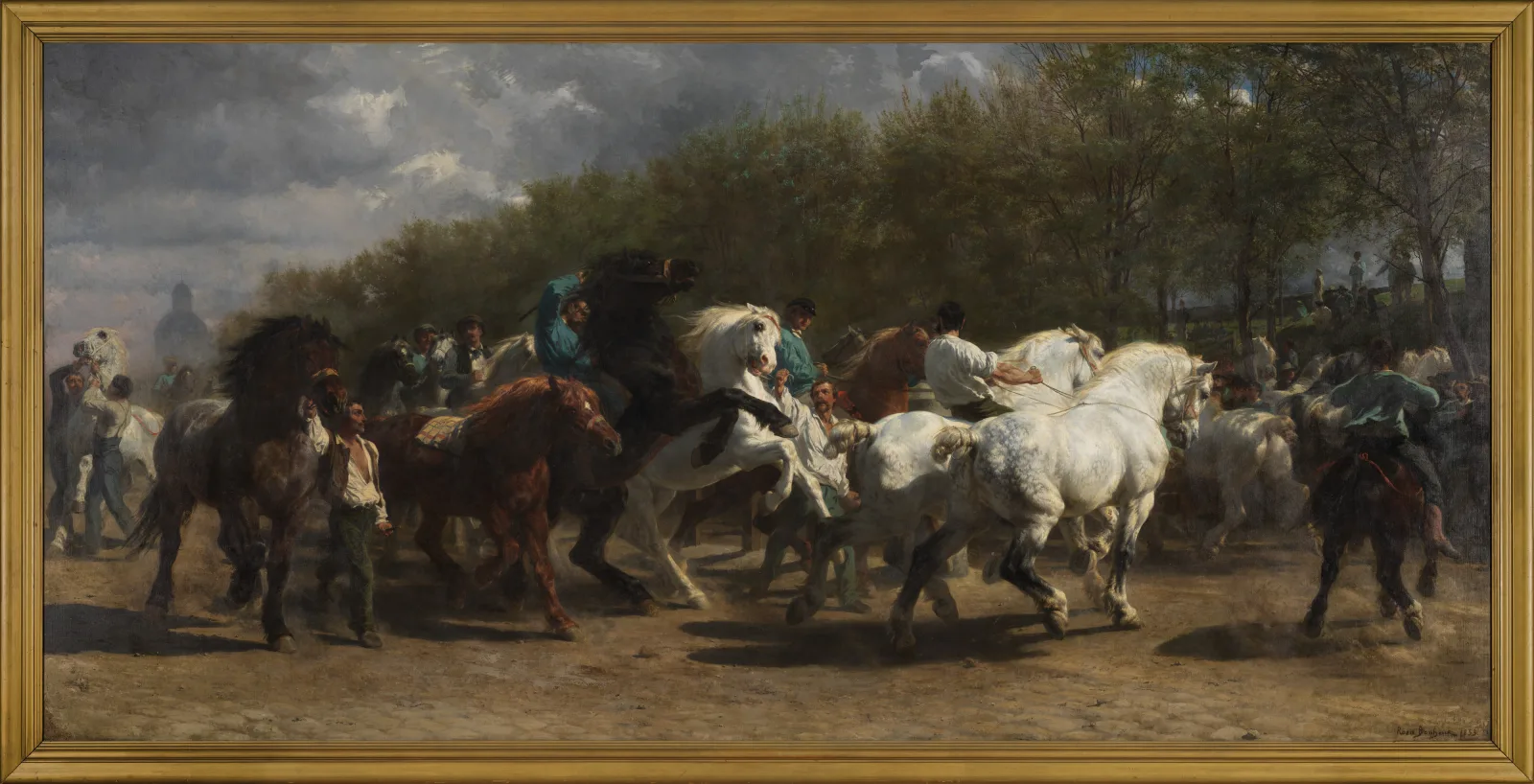
The Horse Fair
Rosa Bonheur · French, 1852–55 · Oil on canvas · The Metropolitan Museum of Art
Bonheur paints the horse as sheer animal force. At the Paris horse market the great draught animals surge and rear under their handlers, a wall of muscle and dust filling a canvas built to the scale of history painting, except the subject is not history, it is horses. To make it, Bonheur obtained police permission to dress as a man and sketch among the dealers, and that fact belongs to the picture: the horse here is freed into pure spectacle, and so, in the making of it, was she. Nothing in the canvas serves a king. It serves the animal.
Collection note
CC0 · met:435702 · Open Museum no. ST-26003-15
Two horse fairs
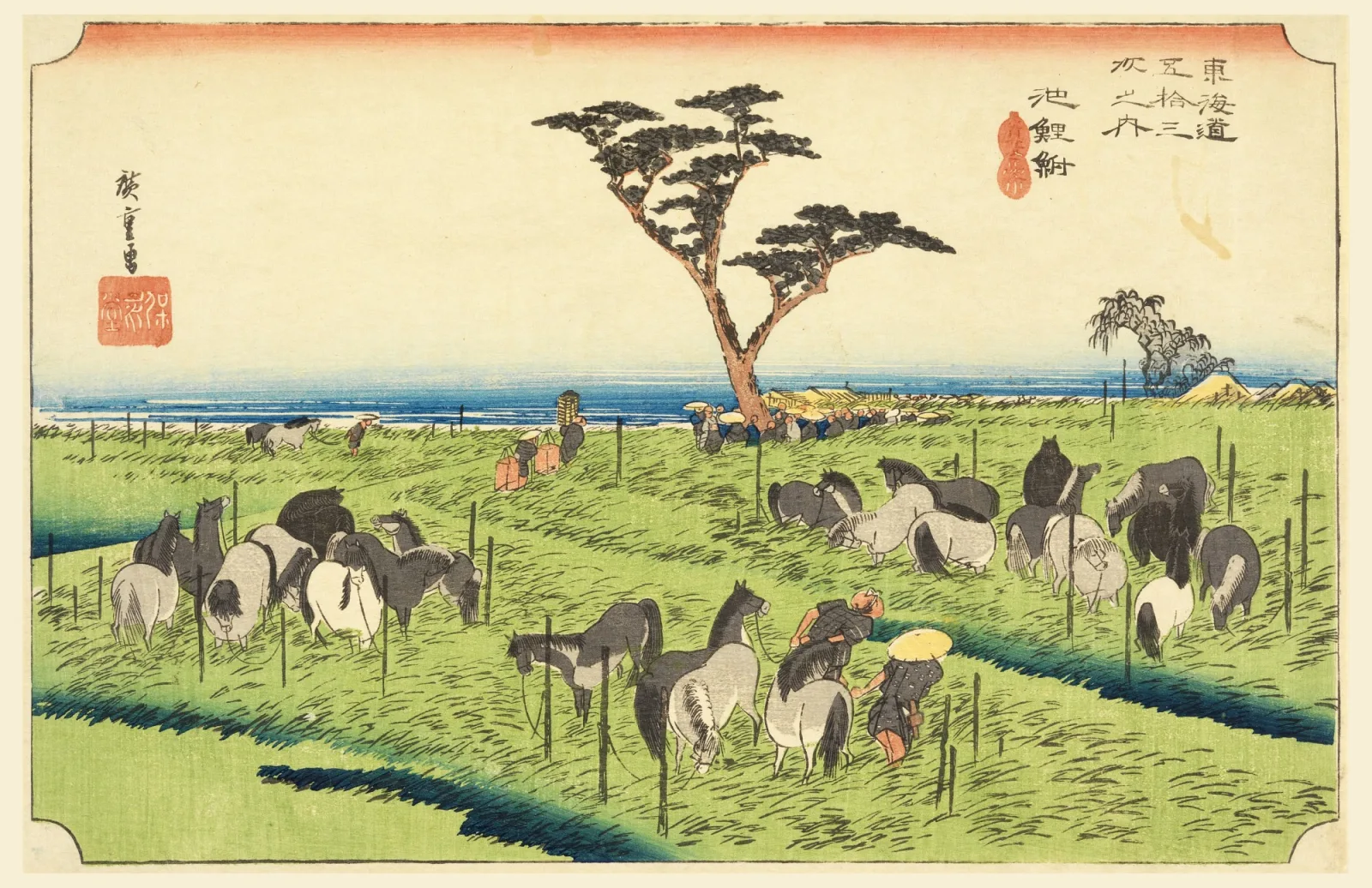
Chiryū, The Horse Fair (Tōkaidō Road) · CC0 · smithsonian:ld1-1643399887910-1643399919132-0 · ST-26003-18
The Horse Fair · Rosa Bonheur · CC0 · met:435702
Before the last turn, hold two pictures of the same human event together. Two painters, two continents, twenty years apart, both at a horse fair. Hiroshige's Chiryū, from the stations of the Tōkaidō road, lays the fair out flat and wide, horses tethered in a spring field under a low band of sky, the scene calm, distributed, seen from a polite distance. Bonheur's Paris market rears up off the canvas in a single surge of muscle, close, loud, frontal. The subject is identical and the seeing could not be more different: one culture notices the order of the gathering, the other its force. Set side by side, they do not resolve into one truth about the horse. They show you that the horse was always also a mirror, and that what each civilisation drew was, in the end, itself. That is the meaning of the animal, complete. What remains is what happened to the animal.
What remains is what happened to the animal
The Overthrow
Every other room asks what the horse meant. This one asks what it took to end it, and the answer is not another animal. It is a machine, and, strangely, a camera. In its last decades the horse was studied more precisely than ever before, and the instrument built to study it became the medium that helped retire it. The horse did not lose a fight; it was measured, dissected, and replaced, and the thing that replaced it kept its name.
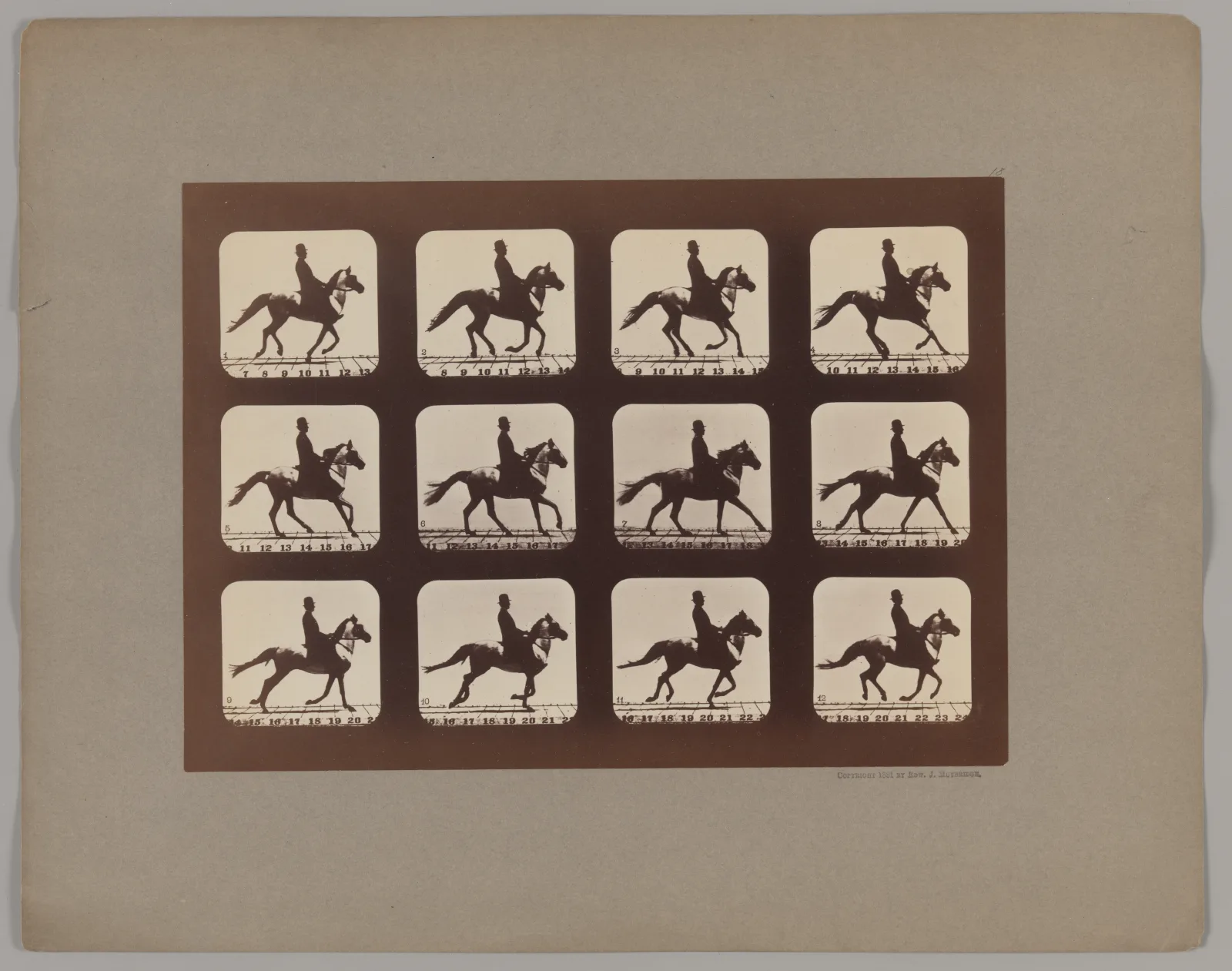
Attitudes of Animals in Motion
Eadweard Muybridge · British and American, 1879 (printed 1881) · Albumen silver print · The Metropolitan Museum of Art
For centuries painters had guessed at the gallop and got it wrong, because the eye cannot hold a stride. In 1878 Eadweard Muybridge settled it with a row of cameras tripped by the running horse itself: at full gallop, for an instant, all four feet leave the ground, and none of the old paintings had it right. This plate is that proof: a strip of frozen instants laid side by side, a motion broken into stills. Run them and you have the moving image. The camera that finally saw the horse clearly was the first machine of cinema, and cinema belonged to the century that would not need the horse. The instrument that studied the animal most precisely became the medium that replaced its world.
Collection note
CC0 · met:700109 · Open Museum no. ST-26003-19
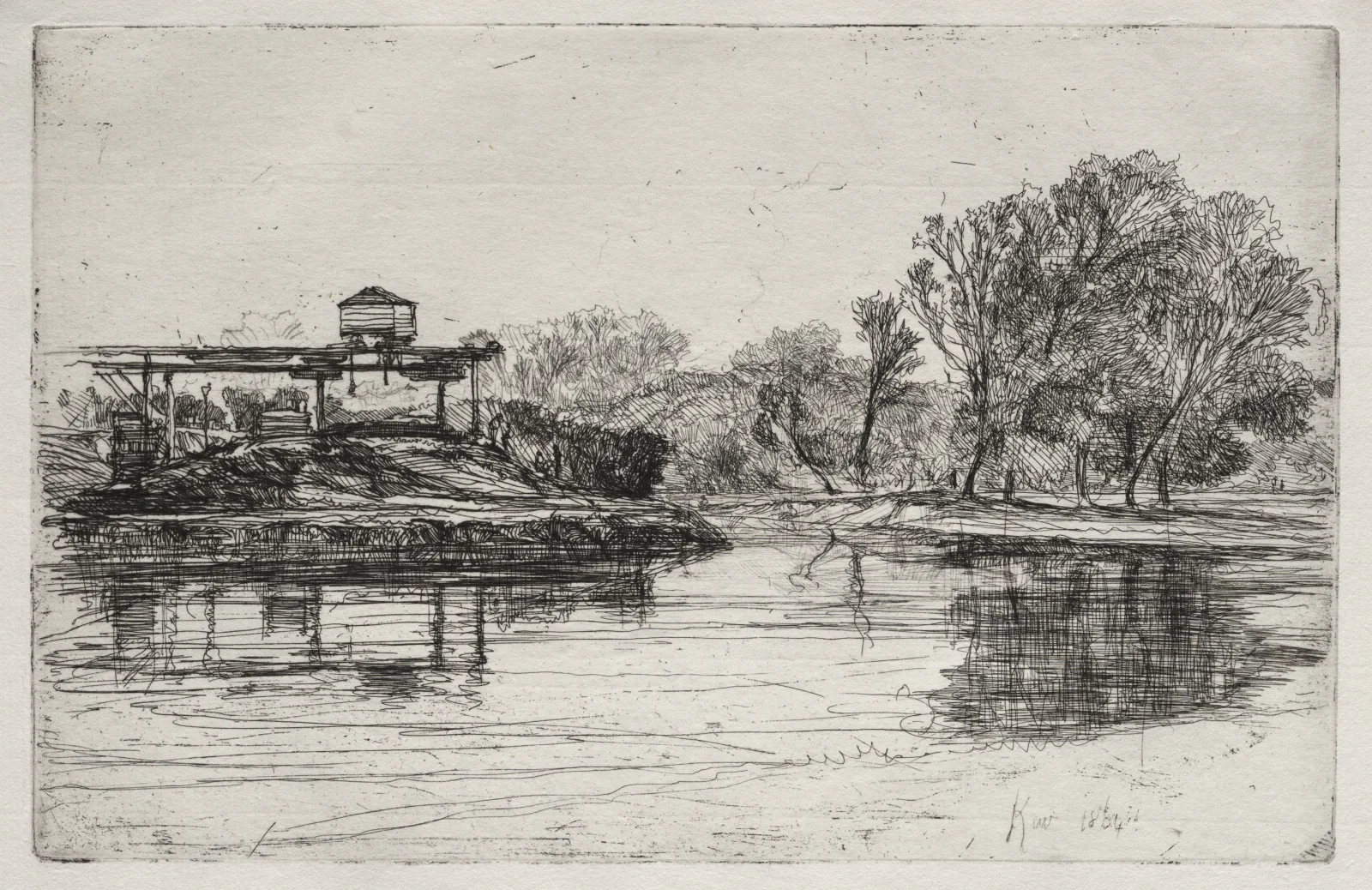
Railway Encroachment
Francis Seymour Haden · British, 1864 · Etching · The Art Institute of Chicago
Haden etches a quiet English river meadow with the new railway pushing across it, the ground itself changing hands, and names the picture for exactly what it shows: encroachment. The horse had owned distance for six thousand years; the engine took it inside a single lifetime, first on rails, then on the road. There is no horse in this plate, and that is the point. This is the landscape at the moment the supercharger changes, drawn by a man who could feel the old order going and chose to record the line where the new one cut in.
Collection note
CC0 · aic:4583 · Open Museum no. ST-26003-20
The machine worship, and the irony
What came next made a religion of the replacement. In the early twentieth century the Futurists declared a roaring motor car more beautiful than any ancient sculpture and worshipped speed as the new sublime, the very thing the horse had supplied for sixty centuries, now reborn in steel and named modern. Those canvases are not on these walls; the exhibition shows the horse, not its heirs. But the heir left one tell in plain sight. We still measure the engine in the animal it retired. Horsepower: the unit that rates the machine is the horse, counted by the dozen and the hundred, ridden by no one. The engine inherited the horse's function and its name. The horse lost the job and kept the meaning.
One animal, six thousand years, six rooms, and no two cultures drew it the same way. The horse was the weapon, the treasure, the king's right, the family's standing, the freed animal of the modern crowd, and at every turn it showed each culture back to itself. Then it was measured, frame by frame, and replaced by an engine that took its work and its name. The function passed on, as the function of a supercharger always does. The meaning did not. What is left on these walls is the meaning: the record, in clay and ink and oil and stone, of everything we asked one creature to be before the machine came for the job.
Every indispensable technology is drawn, for a while, as eternal, and then abstracted into its heir. The horse was the longest-reigning of them, and even it ended as a unit stamped on the machine that replaced it. It cannot tell us how the next of these endings will go. It can only leave the question it spent six thousand years answering: when the new thing arrives, watch whether it takes the function or the meaning. The function is the part that always gets replaced.
This exhibition is the home of a book. What you would be choosing is not a picture of an animal. It is a civilisation's idea of what the horse was for, made to hold.
Open Museum · Essay
The Horse That Changed the World
For six thousand years the horse was the supercharger of human capability, the answer to distance, and at every turn each civilisation drew it as itself. Follow one animal across five cultures and six rooms, and watch what it took, in the end, to replace it.
For six thousand years the horse was the supercharger of human capability. Nothing carried a person, an army, a message, or an empire further or faster, and nothing held that office for longer: the horse kept it from the Bronze Age to the nineteenth century, unseated by no rival animal, retired in the end only by a machine. Its reach is still in our mouths: the single largest language family on earth, spoken today by close to half of all people, was carried out of the grasslands by people who rode. Watch closely, because each civilisation drew the horse as itself. What you are looking at, in clay and ink and oil and stone, is six thousand years of cultures describing their own idea of power, and one animal patient enough to carry all of them.
Room 1
The Weapon
The horse enters history as military technology. It got there twice. First as a ridden animal on the steppe, by a date and a route scholars still argue over; then as the engine of the chariot, a stronger animal bred to pull a light, spoked wheel, which the archaeology fixes among the Sintashta culture, east of the Urals, around 2000 BCE. The room begins with the second, the one we can prove. The chariot made the horse the decisive weapon of the Bronze Age; the Greeks inherited that machine and made it the image of heroic power. Centuries after the chariot was obsolete in war, painters were still reaching for it. This room follows that long afterlife.
Six centuries later the Greeks have decided what part of war to show, and it is not the battle. On this black-figure amphora of about 520 BCE a warrior stands beside his chariot team at the moment of leaving: the horses harnessed, the household watching, the violence still ahead and off the vase. The Greeks chose the threshold, the instant between home and war, and gave the horses the stillness of waiting. The animal here is not yet a weapon in use; it is the line a man crosses to become a soldier.
The earliest horse in this exhibition is painted, not carved, and it is already a status symbol. On this Mycenaean krater of about 1375 BCE, a chariot and its team ride in flat profile around a vessel made to hold wine at the funeral of someone who mattered. The horses are schematic, almost a pattern, but the message is not: to own a chariot was to be the kind of person buried with one painted at your side. The war machine has become an emblem of rank before it has even stopped being new.
Gérôme paints a Roman circus in 1876, the chariots wheeling at the turn, the crowd a blur of marble and heat, every horse strained to the edge of control. Nothing about the technology survives into his century; the chariot is already an antique when he paints it. What survives is the wanting to look. The nineteenth century, on the verge of building machines that would finally outrun the horse, is still picturing the oldest race there is. We never stopped being fascinated, and Gérôme knows it.
The Bronze-Age chariot and Gérôme's 1876 chariot are the same fascination, thirty-two centuries apart.
Room 2 · Tang China, 618–907 CE
The Celestial Horse
For Tang China the horse was precious foreign cargo, brought down the Silk Road from Ferghana, far to China's west, at enormous cost, and it carried a charge of the divine. Emperors were buried with glazed horses to ride in the next world; aristocratic women rode in this one; and the imported Persian game of polo turned the animal into a field of play for the court. The horse here is no weapon: it is wealth, afterlife, and status, fired in clay.
Where the sancai horse stands, this one moves. Built large in white-slipped pottery and painted rather than glazed, it strides with one foreleg lifted, a monumental presence made for the spirit road of a tomb, where figures lined the approach to the grave. Scale is the argument: this is the horse made grand, a funerary guardian sized to impress the living mourner and serve the buried dead. The Tang did not shrink the animal to a charm. They built it to the size of its meaning.
Riding one of these horses, a woman. Tang aristocratic women rode, hunted, and played, and the tombs record it without apology: here a woman sits her mount with an ease the clay makes ordinary. The horse marks a freedom that later centuries in China would narrow. For the length of this dynasty, the most mobile thing a high-born woman could do was the most ordinary thing in the world, and the potter shows it plainly: a person, on a horse, going somewhere of her own.
This is the horse Tang China buried. Glazed in the streaked amber, green, and cream of sancai ware, it stands in perfect stillness, made not to be ridden but to be entombed, so its owner would not go on foot through eternity. The colours are the colours of the Silk Road, the trade route that brought the living animal east at the price of silk by the bale. To bury one in glazed earthenware was to keep, in the tomb, the most expensive thing the empire imported. The horse is treasure, and treasure is what you take to the dead.
The court at play, on a horse that arrived as an idea. Polo came to Tang China from Persia, and with the game came a whole posture of the body: leaning from the saddle, mallet swung, the rider and animal turned into a single line of motion. This small sancai figure carries more than a sport. It carries cultural transmission made visible, a Persian pastime fired in Chinese clay, the horse as the thing that moves customs as well as people. The game points west, toward the next room.
The polo player came to China from Persia. The horse is already carrying culture between civilisations, and Persia is where it goes next.
Room 3 · Persianate painting, 15th–16th c.
The King's Right
In the Persian tradition the highest image of a ruler is a man on a horse doing something difficult: striking a target at the gallop, or riding down game. To ride and shoot like a king was not a metaphor for fitness to rule. It was the proof of it, performed in the saddle and recorded on the page in ink, gold, and bright pigment. This room ends by handing the Persian art of the mounted king eastward, to the Mughal court of India, carried there by the very painter on its central plate.
The royal hunt as the supreme image of rule, and a quiet hinge between two empires. Around 1558 the Persian master Abd al-Samad paints a falcon hunt in a gold landscape, the king mounted, the hawk loosed, the whole world arranged around the rider, exactly the claim this room is built on. But the maker carries a second meaning the page cannot show. Abd al-Samad left Safavid Persia for the court of the Mughal emperors and there founded the imperial painting workshop that would define Mughal art for a century. The Persian way of putting a king on a horse did not stay in Persia. It travelled to India in the hand that painted this. The crossing the next room turns on has already begun, here, in a painter’s biography.
Here is horsemanship as the argument for a throne. Siyavush, the doomed prince of the Shahnama, gallops past a target raised on a pole and twists in the saddle to strike it, the test of riding and aim that a Persian king's son was expected to pass. Painted in the late fifteenth century in opaque colour, silver, and gold, the page makes the skill the point: the prince is legitimate because he can do this, on a horse, at speed. The Persian book of kings does not separate the rider from the ruler. To sit and shoot like this was to be seen as fit to reign.
The same horse carries love as well as power. This small sixteenth-century page shows Shirin, the princess of Persian romance, leaning from her saddle to give water to Farhad, the stonecutter who labours and dies for love of her. The mount that means kingship everywhere else in this room here means tenderness, the same animal, the same gold ground, a wholly different charge. No other tradition in this exhibition asks so much of the horse. Elsewhere it carries a single idea, power, and carries it absolutely; the Persian horse is supple enough to hold a king’s authority and a lover’s mercy without changing its line. That is its distinction on these walls: it is the most human of the animals here, trusted to carry not just the wish to rule but the wish to be kind.
The painter of the falcon hunt, Abd al-Samad, carried this Persian art of the mounted king to Mughal India and built the workshop that ran it. The equestrian image is already moving between civilisations. The next room is where it keeps going, all the way to a Dutchman's drawing table.
Room 4 · Equestrian portraits, 1508–1760
Power Made Visible
The equestrian portrait is the oldest format in public relations. To be painted on a horse was to claim command, to be shown raised, mounted, and in control of a powerful animal that stood for the people and the state beneath you. The format crystallised in Renaissance Europe and then did what no propaganda is supposed to do: it travelled, downward through the classes and outward across civilisations, until a European master sat copying an Indian one whose own tradition a Persian had founded.
The same claim, sovereign in India, and made for a named king. Around 1760 a Mewar painter sets Maharana Raj Singh II on his horse in strict profile, the animal groomed and gilded, the ruler riding across a pale green ground that holds nothing but him. This is not a copy of the European format and owes it no debt; it is the equestrian portrait arrived at on its own terms in Rajasthan, because the logic is the same everywhere a horse means power. To set a king on a fine mount and paint him in profile says the same thing in Udaipur that it says in Dordrecht and Augsburg. The difference is only the throne.
On a single small sheet, the horse crosses civilisations in front of you. Around 1656 Rembrandt, in Amsterdam, sat and copied a Mughal miniature of a nobleman on horseback, drawing an Indian equestrian portrait in his own hand, in brown ink, to learn from it. Set it beside the works it answers, the Mewar king and the Mughal hunt two and three plates back, and the whole thesis of the exhibition stands in one place: the format passed from Persia to Mughal India and on to a Dutch master, not by conquest or the trade in goods but by an artist choosing to study another civilisation’s way of putting a man on a horse. The drawing is small because the surviving sheet is small; keep it that way, and let its smallness sit against the large originals it learned from. The horse is the thing all of these traditions agreed was worth depicting, and the agreement is visible in the lines of a European hand following an Indian one.
The format at its most imperial. Burgkmair cuts the Holy Roman Emperor in armour on a striding horse, the block printed in black and heightened with gold on vellum, an object made to look like sovereignty itself. Everything is pitched to overwhelm: the raised animal, the metal, the gold, the emperor riding out of the page toward you. This is the equestrian portrait doing exactly what it was built to do, turning a man on a horse into the image of a right to rule.
Now the same format steps down a class. Cuyp paints two sons of the Pompe van Meerdervoort family, regents of Dordrecht, on horseback with their tutor and a coachman, in the wide gold light of the Dutch countryside. These are not kings; they are the children of a Republic’s governing class, and they have commissioned the emperor’s format for themselves. The horse that meant sovereignty in Burgkmair’s vellum here means standing, lineage, the confidence of a family that rules a city rather than an empire. The propaganda machine has been bought by the patriciate, and it works just as well a size smaller.
Everything in this room has argued that a man on a horse came to mean power almost everywhere a horse was seen. Here is the furthest proof, cast in brass. The horse reached West Africa across the Sahara by trade, and in the kingdom of Benin the mounted figure, rare and costly in a place where horses were hard to keep, became the supreme image of the ọ́bà's power, with no steppe ancestry behind it and barely a horse to spare. This plaque was cast for that meaning by the Ìgùn Ẹ́rọ̀nwwọ̀n, the court's brass-casting guild, around the middle of the sixteenth century, one of some nine hundred made to sheathe the pillars of the royal palace in Benin City.
It belonged somewhere exact. In 1897 a British force sacked Benin City, sent the ọ́bà, Ọ̀vọ́nránmwẹ̀n, into exile, and plundered the palace. Some two hundred of the palace works went to the British Museum through the Foreign Office; others were sold on the international art market. This one surfaced in England within a year of the sacking, sat in a single collection for six decades, and in 1957 passed through three dealers, in London, Paris, and New York, before entering the collections that brought it to the Metropolitan Museum. It was not acquired. It was taken. The torn edges and the nail holes are the marks of its removal, and we have left them in view.
Its return, and who should decide what is done with its image, are contested and unresolved. We show it because to leave the wall empty would only repeat the erasure, and we say plainly on what terms. No ask has reached us, from Benin City or from Nigeria, that works like this be kept from view. If such an ask comes, we take it down at once.
Room 5 · Nineteenth-century Europe
The Horse Freed
In its final century the horse is released, from king and god and emperor, into science, sport, and the crowd. It becomes a subject for its own sake: raw animal power at a public market, modern speed at the races, a poster on a city wall. For the first time it is painted as itself, not as somebody's claim to power. The room is a freedom and an elegy at once.
Manet turns the horses to face you. At Longchamp the field gallops straight down the track toward the viewer, a compositional shock in 1866, the animals blurred into speed, the crowd a smear of modern leisure along the rail. Earlier centuries showed the horse in profile, the better to admire it; Manet shows it coming at you, because what he is painting is no longer the animal’s nobility but its velocity, the new pace of a century that has started to measure everything. The horse has become modern by aiming itself at the audience.
Finally, the horse becomes a print. Toulouse-Lautrec’s jockey of 1899 is a colour lithograph, the animal seen from behind at full stretch, drawn in the flat, fast line of poster art and made to be reproduced by the hundred. This is the horse entering mass culture, multiplied across paper at the moment its century is ending. Six thousand years as the engine of the world, and the last image of it is a print run, the animal already half a poster of itself.
Bonheur paints the horse as sheer animal force. At the Paris horse market the great draught animals surge and rear under their handlers, a wall of muscle and dust filling a canvas built to the scale of history painting, except the subject is not history, it is horses. To make it, Bonheur obtained police permission to dress as a man and sketch among the dealers, and that fact belongs to the picture: the horse here is freed into pure spectacle, and so, in the making of it, was she. Nothing in the canvas serves a king. It serves the animal.
Comparison chamber
Two horse fairs
Before the last turn, hold two pictures of the same human event together. Two painters, two continents, twenty years apart, both at a horse fair. Hiroshige's Chiryū, from the stations of the Tōkaidō road, lays the fair out flat and wide, horses tethered in a spring field under a low band of sky, the scene calm, distributed, seen from a polite distance. Bonheur's Paris market rears up off the canvas in a single surge of muscle, close, loud, frontal. The subject is identical and the seeing could not be more different: one culture notices the order of the gathering, the other its force. Set side by side, they do not resolve into one truth about the horse. They show you that the horse was always also a mirror, and that what each civilisation drew was, in the end, itself. That is the meaning of the animal, complete. What remains is what happened to the animal.
Room 6 · The last room · into the machine age
The Overthrow
Every other room asks what the horse meant. This one asks what it took to end it, and the answer is not another animal. It is a machine, and, strangely, a camera. In its last decades the horse was studied more precisely than ever before, and the instrument built to study it became the medium that helped retire it. The horse did not lose a fight; it was measured, dissected, and replaced, and the thing that replaced it kept its name.
For centuries painters had guessed at the gallop and got it wrong, because the eye cannot hold a stride. In 1878 Eadweard Muybridge settled it with a row of cameras tripped by the running horse itself: at full gallop, for an instant, all four feet leave the ground, and none of the old paintings had it right. This plate is that proof: a strip of frozen instants laid side by side, a motion broken into stills. Run them and you have the moving image. The camera that finally saw the horse clearly was the first machine of cinema, and cinema belonged to the century that would not need the horse. The instrument that studied the animal most precisely became the medium that replaced its world.
Haden etches a quiet English river meadow with the new railway pushing across it, the ground itself changing hands, and names the picture for exactly what it shows: encroachment. The horse had owned distance for six thousand years; the engine took it inside a single lifetime, first on rails, then on the road. There is no horse in this plate, and that is the point. This is the landscape at the moment the supercharger changes, drawn by a man who could feel the old order going and chose to record the line where the new one cut in.
The writing can only point. The looking is yours.
All works open-access, verified at their source museums. Cite as: [Title]. [Culture, date]. [Museum]. [Licence]. Retrieved via Open Museum. Confirm status at source before commercial or sensitive use.
Every work in this essay lives at open-museum.art. See each in full detail at its source.
Curation and narrative by Open Museum · open-museum.art
The works, in print
From this exhibition · rights-verified at source
A Large Painted Striding Horse Unknown artist · Cleveland · CC0 1.0 Public Domain Dedication Hunting with falcons in a landscape (recto) Abd al-Samad · Cleveland · CC0 1.0 Public Domain Dedication Equestrian Portrait of Maharana Raj Singh II of Mewar (r. 1755–62) Unknown artist · Cleveland · CC0 1.0 Public Domain Dedication The Races at Longchamp Édouard Manet · AIC · CC0 1.0 Public Domain Dedication The Jockey Henri de Toulouse-Lautrec · Cleveland · CC0 1.0 Public Domain Dedication - One print
- The curated set
- Every work
The show’s prints: any single work, the curated set, or the complete print set, museum-grade and rights-verified at source. Take the show home.
The first Open Museum Editions volume
The Horse That Changed the World
All twenty-one works, gathered into one museum-grade volume, printed and bound to keep. The book does not exist yet. We are making it, and we will write to you the day it is ready to hold.