How we think about art, openness, and fairness in an age of reproduction and AI.
A living document · Version 0.1 · 2026-06-30
Why a new code
A museum used to be a building that held things. It decided what the public could see by deciding what it would keep, and its ethics, codified over a century by bodies like ICOM, are the ethics of custody: how to acquire without plunder, how to care for what you hold, when you may let something go.
Open Museum holds nothing. We take no object into our keeping and remove none from anyone else's. What we do is make art findable. We gather works whose rights are clear, prove that status so anyone can check it, credit every maker, and put them where people can reach them. When someone wants to live with a work, we will help them bring it home as a museum-quality print or a verified digital edition, its rights kept clean, visible, and transferable, travelling with the work itself.
We help artists, in turn, hold their own rights well: to understand what they are granting, and to set it where it serves them best. An artist who joins us can use the same infrastructure to be discovered, and to reach the people who find them, as museum-quality prints or as verified digital art.
That is a different operation, and it needs a different code. We have used the great museum codes as a guide to what a serious code must cover, not as a template to fill in. What follows is ours. It rests on three convictions: that art should be open, that makers should be treated fairly, and that in an age when machines can manufacture images without end, the reason to show real human art has to be argued and lived, not assumed.
This is a living document. Where our thinking is still forming, we say so plainly.
The principles
1Open by default
A Mughal Nobleman on Horseback (after a Mughal miniature) · Rembrandt van Rijn · Dutch, c. 1656–61 · Pen and brown ink · The British Museum, London, via Wikimedia Commons · Public domain · [wikimedia:16874622]
Access is the mission, not the product.
We open what we can, as far as we can. Public-domain and CC0 works are reproduced freely; our rights standard is open for anyone to implement, not a walled service. For living artists, openness is calibrated, not maximal: we help each maker find the setting that widens their reach without surrendering their living. For one maker that setting might be: sharing on social platforms, yes; non-exclusive licensing for derivative work, yes; training a machine on their work, no. Another maker sets the dial differently. Their commercial rights, theirs to keep.
In practicean open-access collection; openclearance as an open standard, not a product.
Open questionThe exact rights default we recommend to artists is under research. We will not recommend one until we can show it gives the best available balance of reach and income.
2The work is sovereign
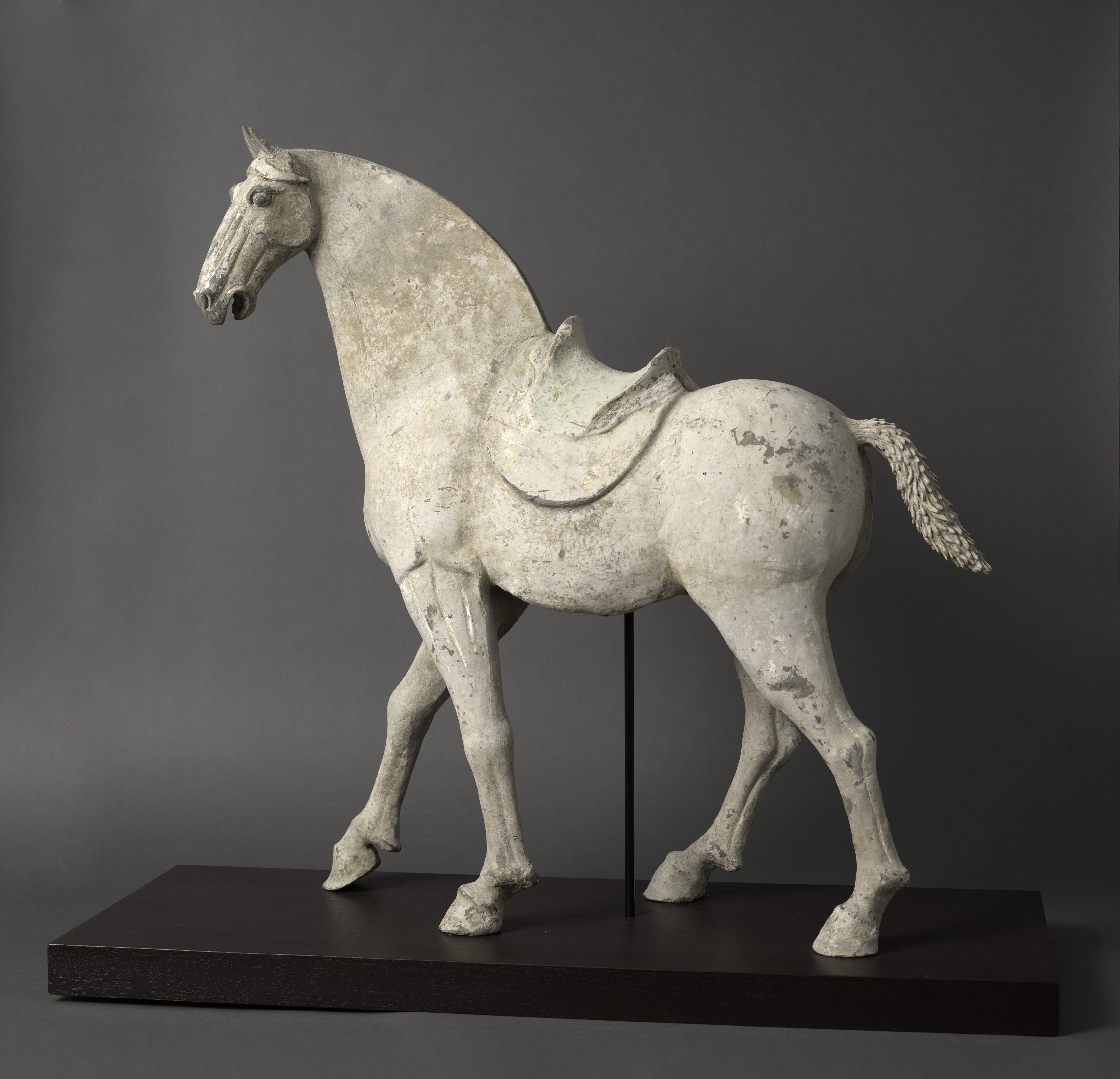
A Large Painted Striding Horse · China, Tang dynasty, 700–800s · Pottery with white slip and mineral colors · The Cleveland Museum of Art · CC0 · [cleveland:84457]
When we show art, the design is about the art. We never overwrite it.
No text, scrim, logo, or crop sits on the work itself. The credit lives beside the image, never across it. A clean view is always one tap away. The presentation serves the work; the work does not serve the presentation.
In practiceno overlays on artwork; the clean-view toggle; credit off-image; art shown full-bleed.
3Rights are proven, not assumed
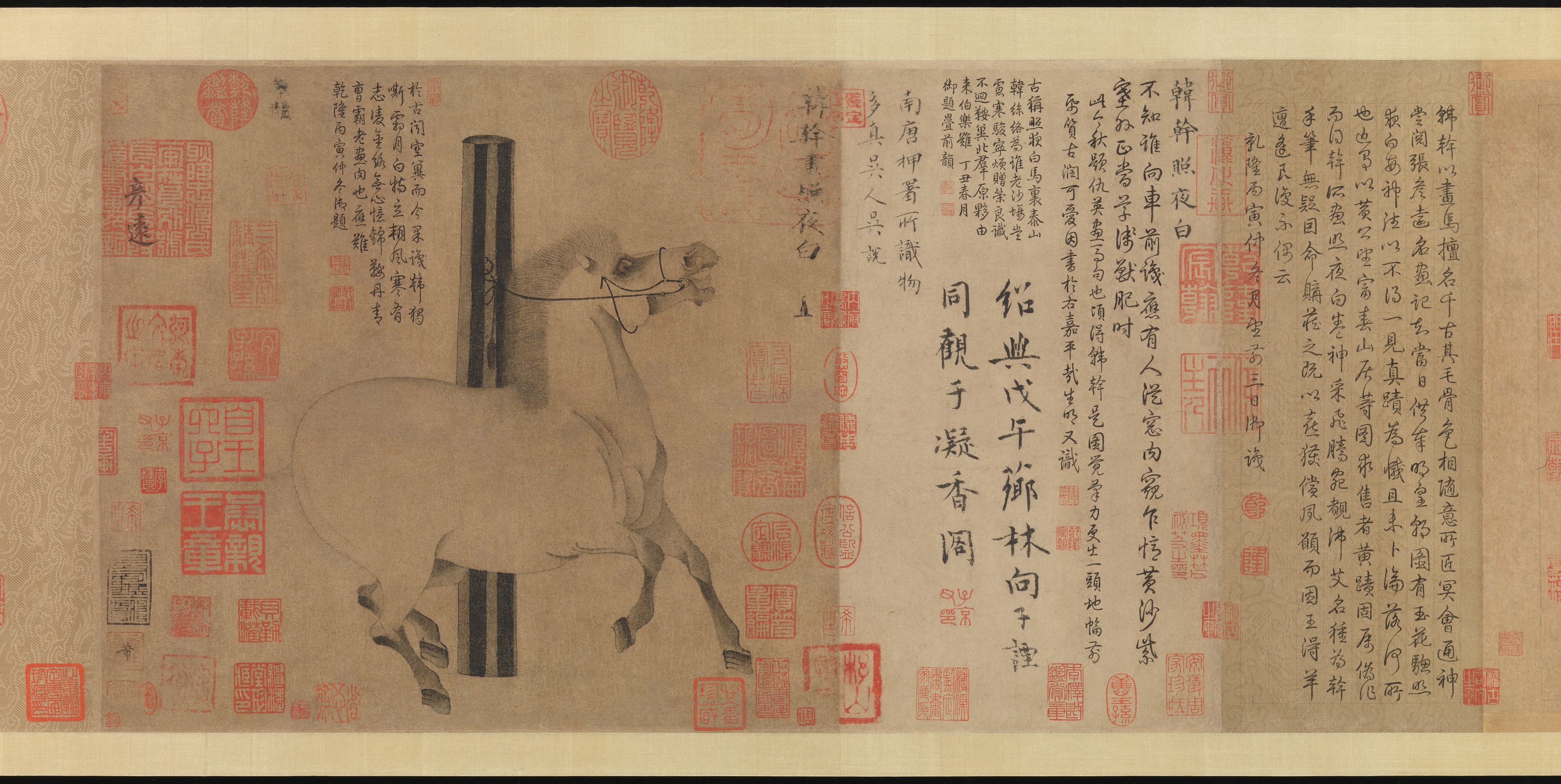
Night-Shining White · Han Gan · Chinese, ca. 750 (Tang dynasty) · Handscroll; ink on paper · The Metropolitan Museum of Art · CC0 · [met:39901]
Every work we show carries a rights record anyone can check. We publish nothing we cannot verify.
A claim of "public domain" is worth only its evidence. Each work resolves to a clearance record naming the source, the field it was read from, and the date it was read. If we cannot verify it, we do not show it. The credit on the wall and the record behind the code must agree, or one of them is wrong.
In practicea clearance manifest per work; the scan-to-verify hook; nothing published without provable rights; credit-matches-verify.
4The maker is never erased
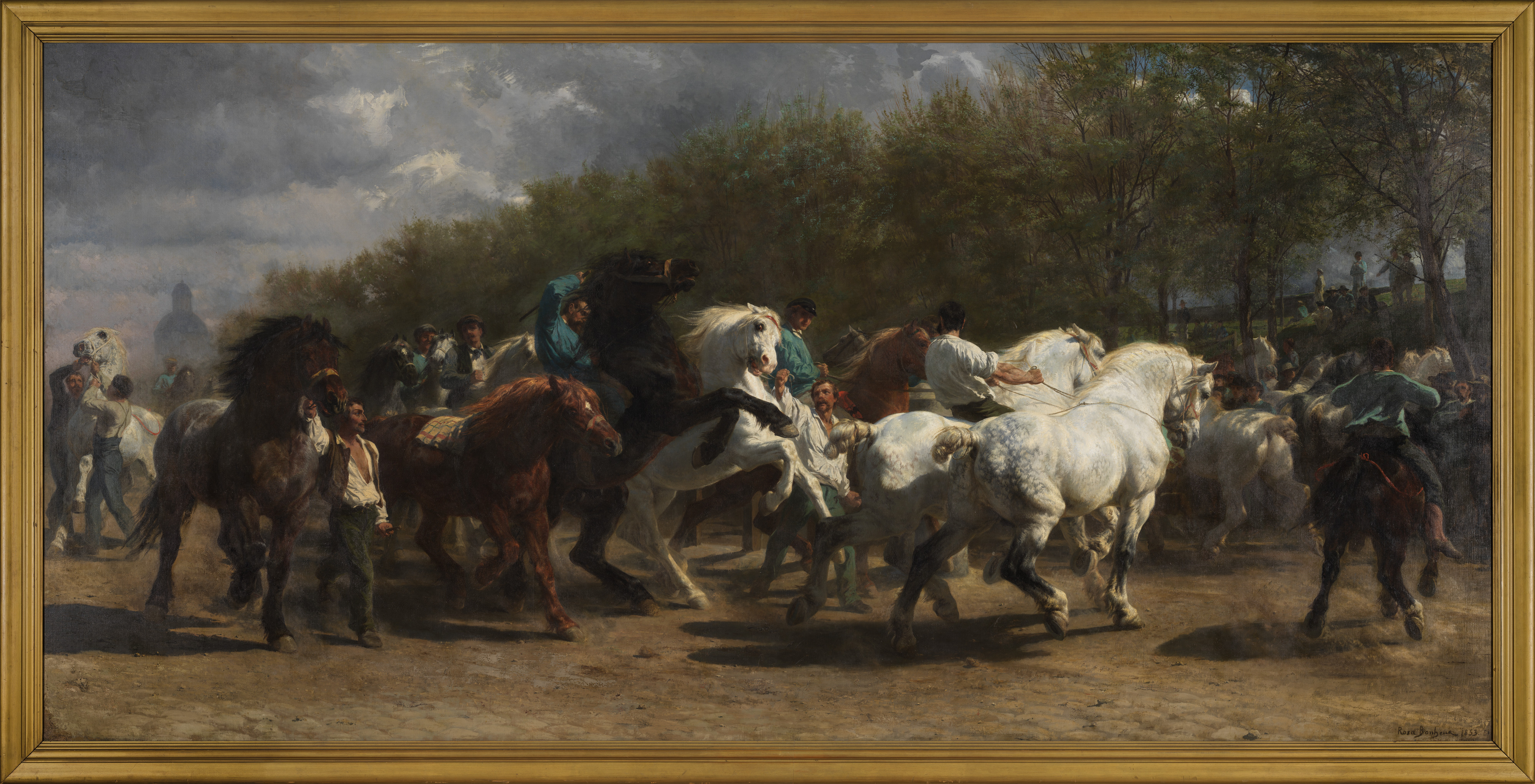
The Horse Fair · Rosa Bonheur · French, 1852–55 · Oil on canvas · The Metropolitan Museum of Art · CC0 · [met:435702]
Every image names its maker, its source, and its rights, even when the law no longer requires it.
Public domain removes the legal duty to attribute. It does not remove the human one. We credit the maker because the work is theirs in the way that matters, whether or not a court still cares. Where a maker is unknown, we say so, rather than let the work seem to have made itself.
In practicethe credit rule on every image (maker, source, licence); attribution by default; "anonymous" named honestly.
5We follow the source, and we are open about provenance
We tell an object's history, including looted and contested histories. And where a living community asks that its work not be shown, we do not show it.
Plaque with equestrian ọ́bà (king) and attendants · Ìgùn Ẹ́rọ̀nwwọ̀n (brass-casting guild) artists · Edo peoples, Court of Benin, Nigeria, ca. 1540–70 · Brass · Taken in the sacking of Benin City, 1897 · The Metropolitan Museum of Art, via Wikimedia Commons · CC0 · [met:310752]
for the works we are asked not to show.
These are the same respect pointing two ways. Where a work was taken by force, as the Benin bronzes were in the sacking of Benin City in 1897, we show the work and tell that truth plainly, including that its return, and control of its image, is still contested. Silence there is not neutrality; it is a second erasure. We hold no objects, so showing takes no side in who should physically hold the bronze. On the image we do take a side, the same one this principle takes everywhere: a request from the Ọba's court that these works not be shown would be honoured exactly as we honour any source community's ask.
But where a source community itself asks that its works not be displayed, above all sacred works, we honour that ask over our own preference for openness. And when a museum's own records cannot separate the restricted works from the rest, we do not guess: we leave the entire source out. We would rather lose a whole collection than show one thing we were asked not to.
In practicecontested provenance told in full; whole sources excluded where consent cannot be cleanly honoured: where a collection's records cannot reliably separate the works a community has asked to keep from view, we leave the entire collection out rather than guess.
6Fair commerce
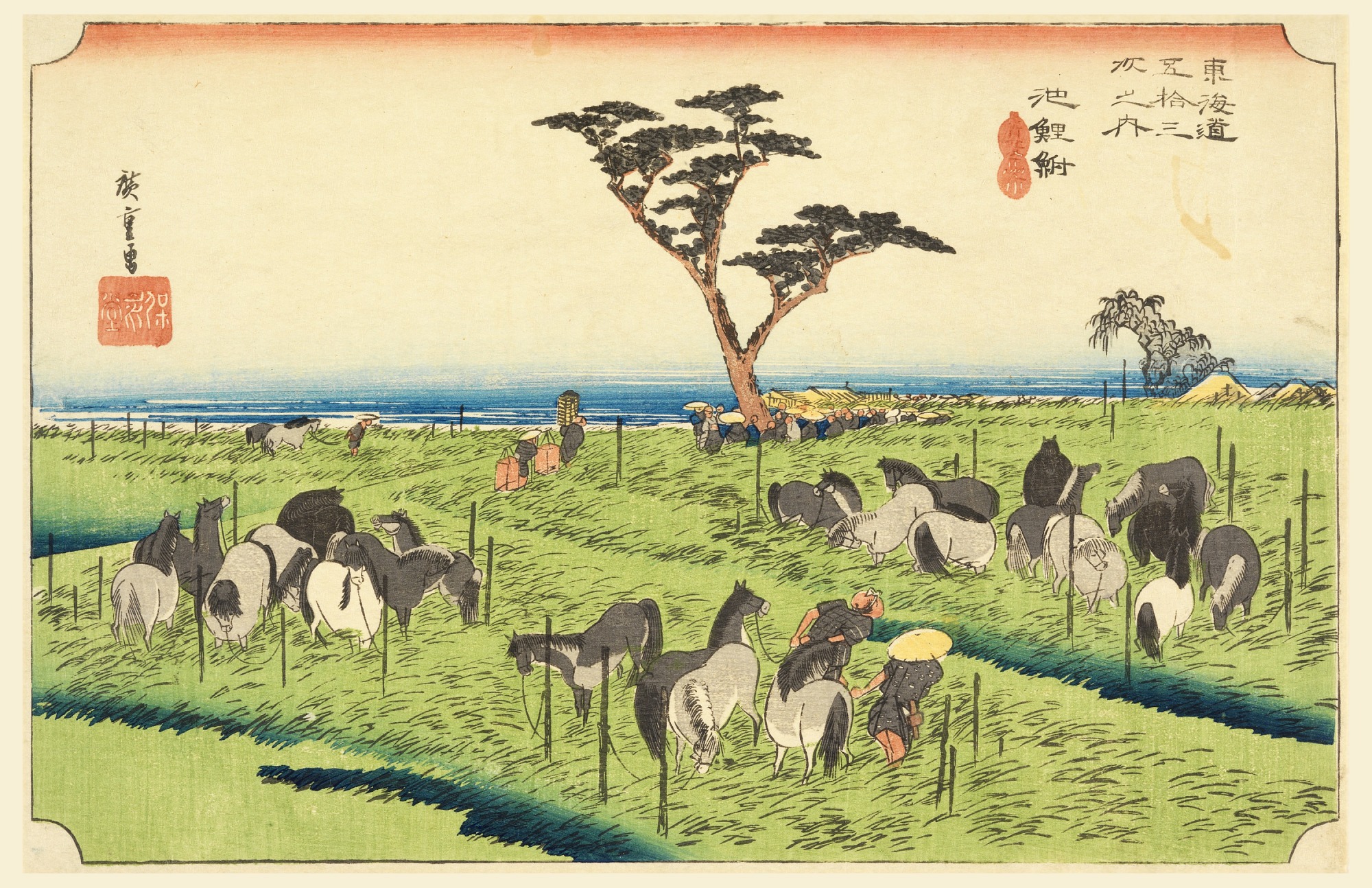
Chiryū, The Horse Fair (Tōkaidō Road) · Andō Hiroshige · Japanese, 1833–34 · Woodblock print · Cooper Hewitt, Smithsonian Design Museum · CC0 · [smithsonian:ld1-1643399887910-1643399919132-0]
When money changes hands, the terms are honest and the maker's share is fair.
Prices follow a stated method, not what the traffic will bear. We do not spring costs on you: the price of a work and its shipping are shown before you buy. Import duties are the one cost we cannot always name, because they are set by the customs of the country a work is sent to, not by us, and may fall due on delivery. We say so plainly rather than let them arrive as a surprise. When we sell a living artist's work, the split is on real margin and weighted to the maker. Some works we will show but never sell: where a community's protocol allows a work to be seen but not traded, we display it and keep it out of commerce entirely. And when we state an edition limit, we keep it. A cap stated is a cap kept. We also plan for the day our gate fails us: if a rights claim behind a work you bought later proves wrong, we will tell you plainly, and we will amend the work's verify record in the open, dated, never deleted.
In practicea stated pricing method; price and shipping shown before purchase; import duties flagged plainly as set by the destination country, not us; the artist-weighted margin split; works under cultural protocol shown but never sold; stated edition limits enforced; a post-sale correction path: plain notice to the buyer, the record amended in the open, dated, never deleted.
7Art in the time of AI
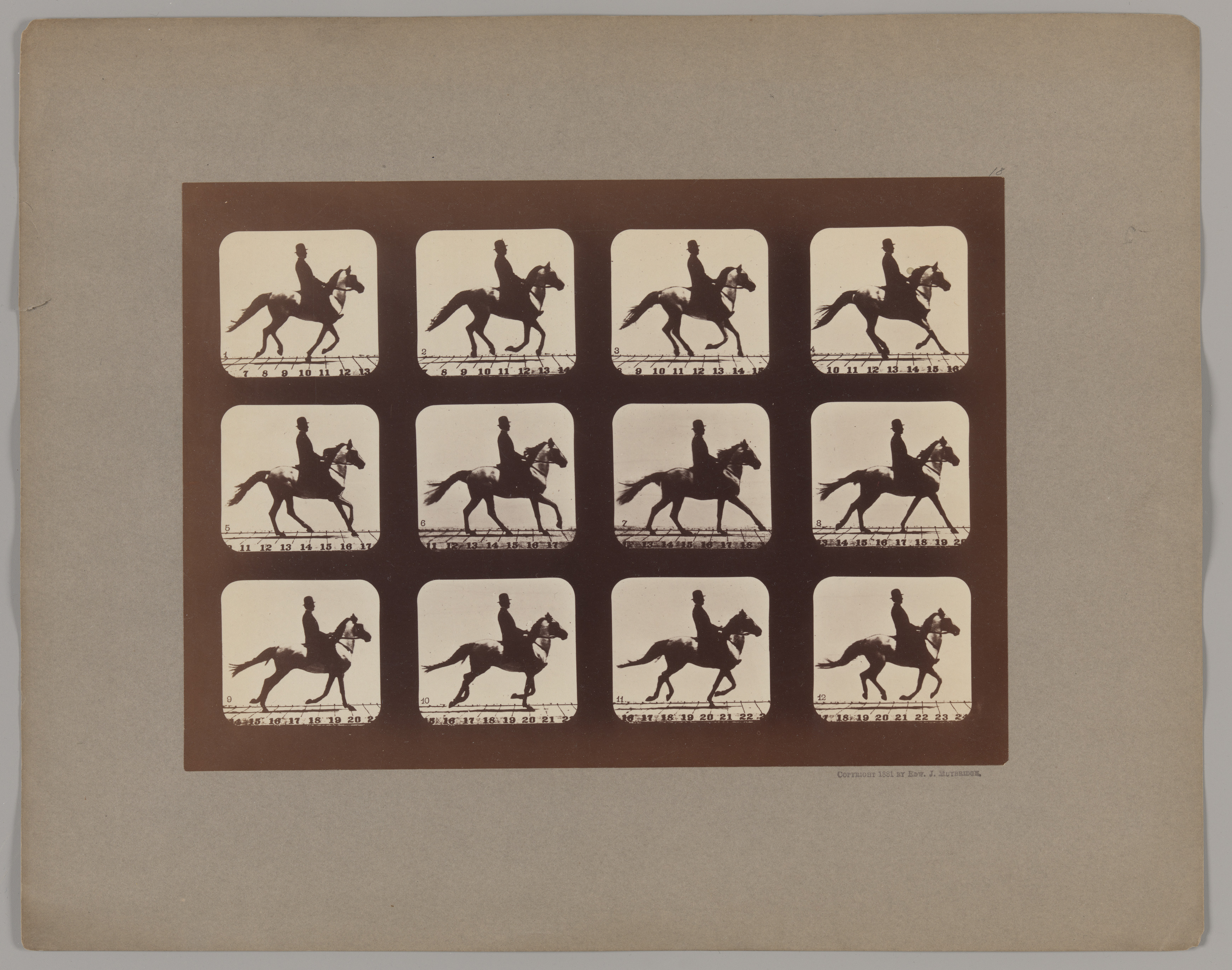
Attitudes of Animals in Motion · Eadweard Muybridge · British and American, 1879 (printed 1881) · Albumen silver print · The Metropolitan Museum of Art · CC0 · [met:700109]
We are not against machines. We are for the real thing being the easy thing.
A machine can now make an endless supply of images. We use such machines as tools, to help us build and to narrate a tour in our own words. What we will not do is put a synthetic image on any surface of ours, or let a machine speak as an artist. Our reason is not fear; it is arithmetic. There are millions of works of real human art within reach. For someone choosing art to live with, the advantage AI-generated art holds over them is convenience: it is easy, and it asks nothing of you. So the honest answer is not to ban it but to beat its one advantage, to make real art as easy to reach, and to do the curation and the thinking so that the easy choice is also the true one.
In practiceno synthetic imagery on any OM surface; AI as tool and as tour-narrator only, never as artist or as the artwork; provenance signals that let the real and the synthetic be told apart.
Open questionOur fuller position on AI-generated art is still forming. This is where it stands, and the essay experiments are the live test.
8We verify, and we correct in the open
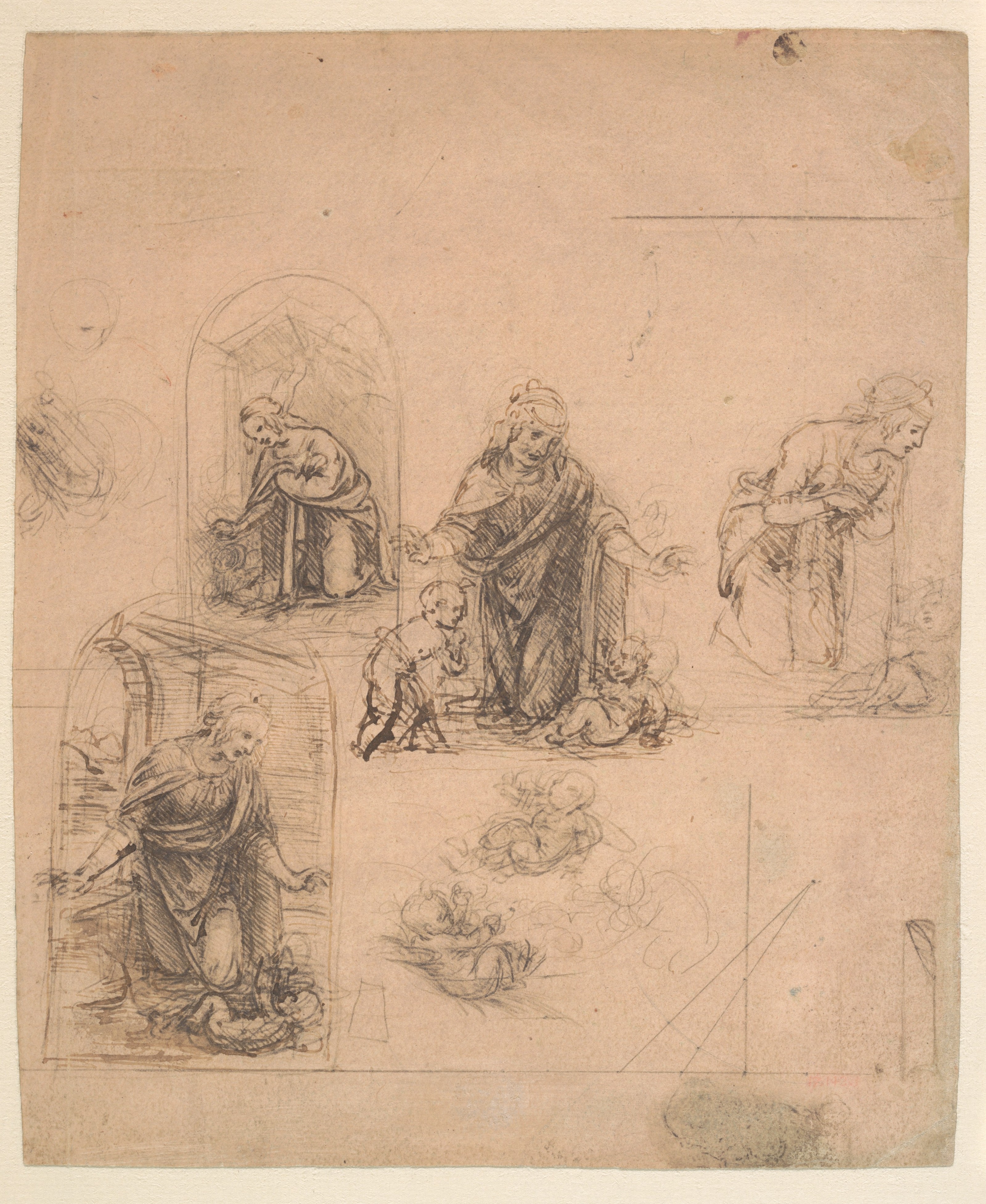
Compositional Sketches for the Virgin Adoring the Christ Child, with and without the Infant St. John the Baptist · Leonardo da Vinci · Italian, 1480–85 · Silverpoint, partly reworked by the artist with pen and dark brown ink · The Metropolitan Museum of Art · CC0 · [met:337494]
We try to get everything right. When we are wrong, we correct it in the open.
The gate is principle 3: nothing is shown without a rights record checked against its source. This principle is for what the gate cannot promise, because anyone handling this much will sometimes be wrong. Our promise is not that we never make a mistake; it is what we do when we are told of one. We check it, we correct it, and we record the change with a date, so the fix is visible and nothing is quietly rewritten. This document works the same way: a living text, versioned, its reasoning open to being seen to change.
In practicecorrections made and dated when we are made aware; a standing channel for telling us: corrections@open-museum.art; this code and our records kept under version control.
9We widen the door
New Year's Eve Foxfires at the Changing Tree, Ōji (One Hundred Famous Views of Edo, no. 118) · Utagawa Hiroshige · Japanese, 1857 · Woodblock print · Brooklyn Museum, via Wikimedia Commons · Public domain · [wikimedia:11158510]
We argue, loudly, that art belongs to more people, and that a print is not a lesser thing.
Our favourite model is the woodblock, and we hold it up for what it honestly proves. The ukiyo-e print was not a copy of some finer original; the woodblock was the original medium, made to be many, and it put beauty on ten thousand walls without being one degree less art for it. It proves that a print can be a work of art in its own right, not that a reproduction equals the painting it reproduces: scale, material, and the presence of the one surface the maker touched are real things, and a print does not pretend to them. It does its own work. That is the side we choose. We evangelise openclearance and open access to artists and to museums, not as a tactic but because more people living with real art is the whole point.
In practiceopenclearance advocacy to institutions and artists; a print ladder that puts museum-grade work within reach; "good art is good art, printed or original," held publicly.
The living document. This is version 0.1, dated 2026-06-30. It will change
as we learn, and every change will be dated. Two questions are open by our own admission: the
exact rights default we recommend to artists (1), and our fuller position on
AI-generated art (7). We would rather show the working than claim a finished
certainty we do not have.